 Hospital
You You We, Go Go Go!
Hair Transplant
Also known as:
- FUE Hair Transplantation
- Hairline Restoration
- Androgenic Alopecia Treatment
- Hair Grafting
Recovery
- Mild redness or swelling typically lasts only a few days
- Most clients return to light daily activities within 2–3 days
Considering Hair Transplant?
Compare transparent pricing from vetted specialists in minutes.
About Hair Transplant
Treated areas:
- Hair
- Hairline
HAIR TRANSPLANT: Restore Natural, Permanent Hair
Minimally Invasive | Lifetime Natural Growth
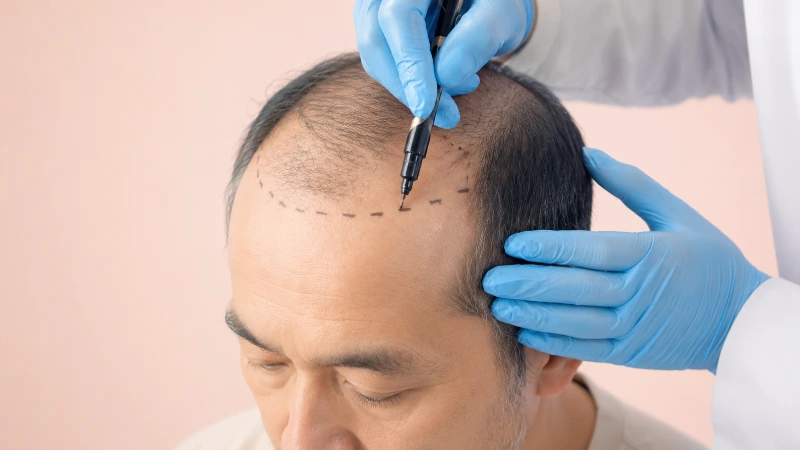
A hair transplant is a safe, minimally invasive procedure that restores hair by moving healthy hair follicles from areas where you have plenty (usually the back or sides of your head) to thinning or balding areas. These transplanted hairs are genetically resistant to the hormones that cause hair loss, meaning they will continue to grow naturally for a lifetime.
✨ FUE (Follicular Unit Extraction)
- The most popular modern method. Individual hair grafts are extracted one by one and carefully placed into the recipient area.
- Benefits: No linear scars, very fast recovery, completely natural appearance, and suitable even if you prefer short hairstyles.
✨ DHI (Direct Hair Implantation)
- An advanced version of FUE using a specialized precision pen tool to place hair follicles directly into the scalp without prior incisions.
- Benefits: Achieves higher density, provides perfect control over the angle and direction of growth, and ensures minimal handling of grafts for a higher survival rate.
What You Will Achieve
✅ Natural, Permanent Hair Growth: Transplanted hair grows permanently, is genetically resistant to further loss, and looks exactly like your original hair.
✅ Restored Hairline & Forehead Shape: Lowers high or receding hairline; creates a smooth, natural, youthful front contour; balances forehead proportions.
✅ Thicker, Denser Coverage: Fills thinning areas, bald spots, or patchy loss; adds fullness across crown, top, or sides; achieves dense, healthy‑looking volume.
✅ Defined Eyebrows, Beard & Body Hair: Restores or thickens eyebrows, beard, moustache, chest, or scar areas; shapes clear, neat, well‑defined outlines.
✅ Natural Direction & Flow: Placed to match your original growth angle and pattern; blends seamlessly so no one can tell it was done.
✅ Full Styling Freedom: Cut, colour, wash, and style normally, no special care, no daily treatments, no limits after healing.
✅ Corrected Unevenness or Scars: Covers scars from injury, surgery, or old procedures; fixes patchy growth or asymmetry.
✅ Long‑Term Stability: Results last a lifetime; no repeated costs or upkeep unlike wigs, creams, or medications.
✅ Boosted Confidence & Youthful Look: Looks younger, more balanced, and complete; feel more self‑assured in every situation.
✅ Safe, Natural Results: Uses only your own hair; no allergies, no rejection; designed to suit your face shape and features.
Ideal Candidate
You are a perfect candidate if you:
- Experience male or female pattern baldness or significant thinning hair
- Have enough healthy “donor hair” available on the back or sides of your head
- Want a permanent solution for a receding hairline or thinning crown
- Are in good general health and seeking natural looking restoration
- Desire a long term fix that requires no daily maintenance or temporary covers
Price by Region
| Location | Ranging from |
|---|---|
| Korea | 7,800,000 (KRW) |
| Thailand | 160,000 (THB) |
| China | 25,000 (RMB) |
| Japan | 1,300,000 (JPY) |
| Malaysia | 17,500 (MYR) |
| Singapore | 12,500 (SGD) |
| Indonesia | 60,000,000 (IDR) |
Real Results
How It Is Performed
Pre-operative dermatoscopy and hair-loss staging photography; safe-zone mapping
- Donor area trimmed; local anaesthesia infiltrated throughout the donor and recipient zones
- Specialised 0.7–0.9 mm micro-punch rotates around each follicular unit, separating it from surrounding tissue without damaging the follicle
- Individual graft units extracted and immediately transferred to chilled isotonic saline (4 °C) to maintain viability
- Recipient site channels created at precise angles, depths, and directions — this artistry determines the ultimate naturalness of the hairline
- Each follicular unit carefully seated using fine forceps or an implanter pen, ensuring correct orientation
- Protective dressing applied; post-operative photographs taken- Total out-of-body time for grafts is kept below 6 hours — the critical window for maximum survival
Hospitals Offering This
Hospital Hospital
Kamol Hospital Cosmetic & Plastic Surgery
View Hospital → Hospital
Guangdong Clifford Hospital Cosmetic Surgery Center
View Hospital → Hospital
Chongqing Junke Plastic Surgery Hospital
View Hospital → Hospital
Cido Medical Beauty Clinic
View Hospital → Hospital
Sunshine Medical Cosmetology Hospital
View Hospital →

















Your Timeline
Preparation
- Blood work and scalp dermatoscopy assessment; hair-loss stability confirmed
- Stop minoxidil 2 weeks before surgery
- Smoking cessation 4 weeks before; no alcohol 7 days before
- Treat any active scalp infection or dermatitis (psoriasis, seborrhoeic dermatitis) before scheduling
- Ensure controlled management of diabetes or hypertension if present
Followup Care
- Saline misting to grafts; no shampoo for 48 hours
- Gentle cleansing wash from day 3
- Post-op finasteride and/or minoxidil if clinically indicated
- Sleep with head elevated for 5 days; no tight hat or helmet for 7 days
- No swimming or sauna for 4 weeks; no hair dyeing or perming for 6 months
- Reviews at 1, 3, 6, and 12 months
Frequently Asked Questions
Is FUE hair transplant permanent?
Yes. Donor follicles from the occipital safe zone are genetically resistant to DHT (the hormone responsible for pattern hair loss) and will continue growing permanently at the recipient site.
Is the shock loss phase alarming?
No, it is completely normal and expected. Transplanted hairs shed 2–4 weeks after surgery as they enter a rest phase before regrowing. This is not a sign of failed transplantation.
How do I know if my hair loss is stable enough for transplant?
Your dermatologist or surgeon will assess the pattern, rate, and scalp dermatoscopy findings. Generally, hair loss should have been stable for at least 12 months. Medical therapy (finasteride / minoxidil) may be recommended for 6–12 months before transplant to stabilise progressive loss.
How many grafts do I need?
The number depends on the extent of hair loss and desired density. A typical hairline restoration requires 1,000–1,500 grafts; crown coverage may require 2,000–3,000 grafts. Your surgeon will plan the number based on your consultation and dermatoscopy.
Can I have a hair transplant if I am a woman?
Yes. Women with stable androgenic or traction alopecia are good candidates for FUE, particularly for hairline refinement or crown densification. Consultation with a dermatologist to determine hair-loss pattern is essential.
Will I need medication alongside the transplant?
Finasteride (for men) and minoxidil may be recommended to stabilise existing hair loss and protect native hairs from further thinning, complementing the transplant result.
· Next Step
Interested in Hair Transplant?
Connect with accredited specialists and get a personalised plan.