
Acne Scar Treatments: What Works for Which Scar Type
Key takeaways
- The right approach depends on your scar shape. Narrow deep scars are treated one at a time, broad shallow ones respond to resurfacing a whole area, and scars tethered down from underneath need that tethering released first.
- Most people need a combination, not one procedure. Each approach solves a different problem, and having more than one type of scar is normal.
- Creams and pigment lasers do not change texture. Both are useful, but for color, which is a separate problem from an indentation.
- Expect several sessions, spaced weeks apart. This matters more than usual if you are considering treatment in another country.
- The realistic goal is meaningful improvement, not skin that looks like it never broke out. Depth is the biggest limiter, and results keep developing for months after the last session.
If you’ve spent money on serums that promised to fade acne scars and watched nothing change, that is not because you used them wrong. An indented scar is a change in the structure of the skin, and almost nothing applied to the surface reaches that far down.
This guide is about indented scars, the kind you can feel as a change in texture. If what’s bothering you is flat and only a difference in color, start here instead, since marks and scars need opposite treatments. If you know it’s texture but not which shape, this covers telling them apart.
Quick Match: Which Treatments Suit Which Scars
Tap any approach in the table to jump straight to it. Almost nobody matches only one row. Mixed scarring is normal, and most treatment plans use approaches from more than one row.
What Won’t Fix Texture, Even Though It Gets Suggested
Before we cover what does work, here are two things that do not. This is where people spend money first:
Creams and skincare don’t change texture. Retinoids and similar actives genuinely help skin quality, help pigment, and help prevent new breakouts, all of which is worthwhile. What they don’t do is refill a depression or rebuild the collagen structure underneath one. If a scar is indented, no topical product is going to level it.
Pigment treatments don’t change texture either. Brightening lasers and IPL work on color, and they work well for the flat brown and red marks left behind after breakouts. They do nothing for an indentation. This is one of the more common mismatches in acne scar treatment, because “we have lasers” covers two completely different jobs, and a laser bought for pigment work is not the same tool as one bought for resurfacing.
If you’re not certain whether what’s bothering you is texture or color, it is worth confirming that before you pay for anything. The two need opposite tools.
Releasing Scars That Are Tethered Down (Subcision)
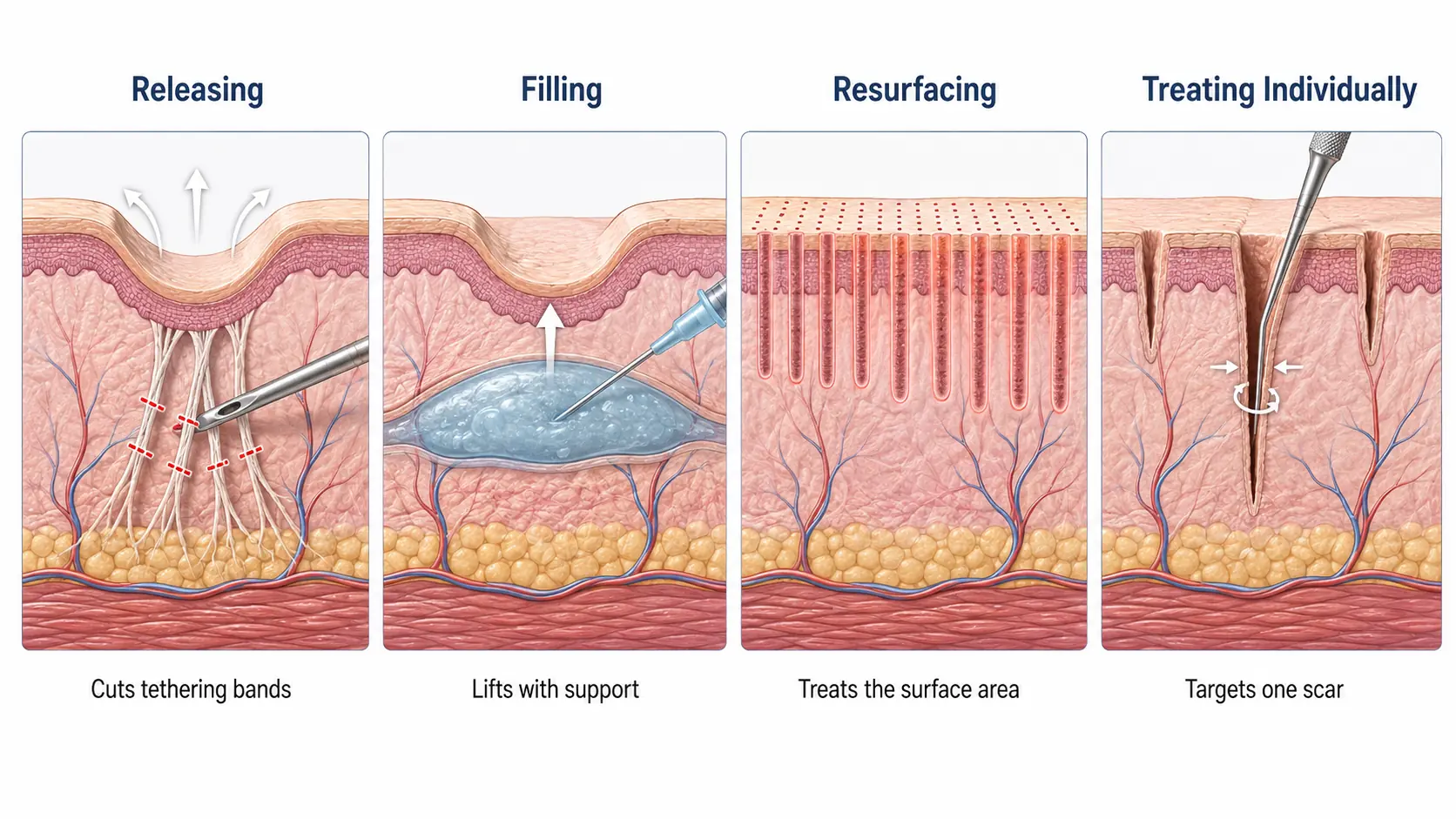
Subcision treats scars that are being pulled down from below. A doctor passes a fine needle under the scar and releases the fibrous bands anchoring it to deeper tissue, which lets the surface lift back up.
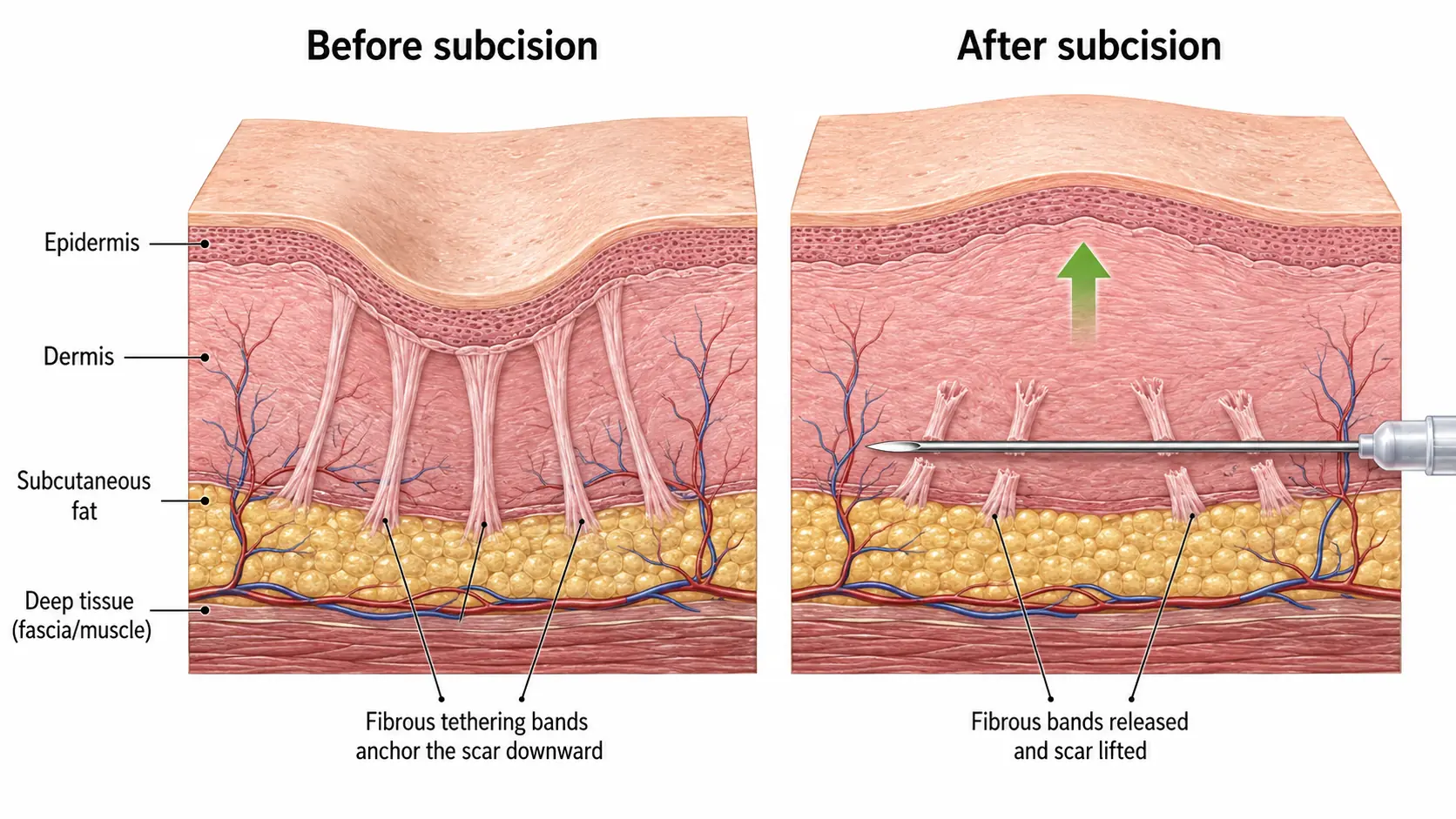
It’s mainly used for rolling scars, the broad wavy ones that shallow out when you stretch the skin. That stretch response is a decent clue that tethering is involved, and tethering is exactly what this addresses.
This matters more than most people expect. While a scar is still anchored down, treating only the surface cannot lift it. Comparative studies have found subcision performing well against surface treatments for this particular scar type, which is not the result most people expect from a procedure that involves no laser at all.
It’s usually done over a small number of sessions, and it’s very often paired with something that fills or supports the space underneath, since released tissue can re-tether otherwise.
Filling and Supporting the Dip (Fillers, Collagen Stimulators, Fat Transfer)
These add volume under a depression so the surface sits level again. Three broad options, and they behave quite differently:
Hyaluronic acid filler is a gel injected under the scar. The improvement is visible immediately, which makes it the most satisfying option in the short term, and it’s often reported as lasting somewhere in the range of a year or two before it gradually resorbs.
Collagen stimulators do the reverse. These don’t fill the space directly. They prompt your own skin to build collagen there over the following weeks, so nothing much appears to happen at first and the result builds gradually. But the results are generally reported as lasting longer than hyaluronic acid.
Fat transfer takes fat from elsewhere on your body, processes it, and injects it into the depressed area. How long it lasts depends on how much of the transferred fat establishes its own blood supply and survives, which varies more between people than the injectable options do.
Filling is frequently done in the same visit as subcision, since a scar that has just been released is a good candidate for something that keeps the space open.
Resurfacing the Whole Area (Fractional Lasers and RF Microneedling)
Resurfacing treats an area rather than individual scars, by creating controlled micro-injuries that prompt the skin to rebuild collagen and smooth out over the following months.
Fractional lasers deliver that injury as a grid of tiny columns, leaving untreated skin in between to speed healing. Ablative versions such as fractional CO2 work deeper with more downtime, non-ablative versions are gentler with less.
Radiofrequency microneedling uses fine needles to deliver energy below the surface, working below the surface and leaving the top layer of skin intact. That combination is often preferred where downtime or pigment risk is a concern.
Here is something most international guides leave out. On medium and deeper skin tones, resurfacing carries a real risk of the treated area darkening afterward, an effect called post-inflammatory hyperpigmentation. It’s usually temporary, but it can take months to settle. And it’s genuinely more common in skin that tans easily and rarely burns, which covers most people across East and Southeast Asia. (Dermatologists call that range Fitzpatrick types IV to VI.)
This isn’t a reason to rule resurfacing out. It’s a reason to ask two direct questions: how will the settings be adjusted for my skin tone, and how many sessions are you planning? Be careful with any clinic that treats either question as unimportant.
Resurfacing is the most session-dependent option here, typically several treatments spaced weeks apart, with results continuing to develop for months after the last one.
Treating Scars One at a Time (TCA CROSS and Punch Techniques)
Some scars are too narrow and too deep for anything that works across a whole surface to reach the bottom of them. Ice pick scars are the clearest example. These get treated individually.
TCA CROSS applies a small amount of a strong acid precisely into the opening of a single scar, prompting it to heal from the base upward so it becomes shallower over successive sessions. Nothing is applied to the surrounding skin.
Punch excision takes a small circular instrument to cut out the whole scar and close the tiny wound with a stitch, which leaves a small flat line instead of a deep pit. It’s used on deep ice pick and narrow boxcar scars where the depth makes other approaches impractical.
Punch elevation is a variation for boxcar scars with a healthy flat base: the base is cut free and lifted up to sit level with the surrounding skin instead of being taken out entirely.
All three usually need several sessions to treat all the individual scars on a face, and resurfacing afterward to blend everything together.
The Add-Ons: PRP, Exosomes, Rejuran, Skin Boosters
These appear constantly on clinic menus, so it is worth being clear about what they are. PRP (made from your own blood), exosomes, Rejuran, and injectable skin boosters are used alongside the treatments above, mainly to support healing after a procedure or to improve overall skin quality.
These support the other treatments. They do not replace them. On their own they will not resolve an indented scar, because they aren’t addressing the structure that makes it indented. That doesn’t make them pointless, recovering faster and better from a resurfacing session has real value. It does mean a plan built only from these, with no procedure doing structural work, is unlikely to deliver what someone with true scarring is hoping for.
Why Most Plans Use More Than One Approach
The pattern across the clinical literature is fairly consistent: combining approaches tends to outperform any single one used alone for indented acne scarring.
The reason is visible in everything above. Each approach solves a different problem. Releasing does nothing for volume. Filling does nothing for a scar that’s still tethered. Resurfacing can’t reach the base of an ice pick scar. Someone with mixed scarring, which is most people, has more than one problem to solve, so the plan usually has more than one component, often sequenced across several visits rather than done all at once.
This is also why comparing clinics on “which single treatment do you offer” is the wrong question. What matters more is whether they’re assessing which of these problems you actually have.
What Kind of Result Is Realistic?
The short version is in the takeaways above: improvement, not skin that looks like it never broke out. Here is what that means in practice.
People who are happy with their results tend to describe it the same way. The scarring is no longer the first thing they see in the mirror. You cannot see it from across a room. It is not gone, and they stopped thinking about it.
Three things set how far you get:
- Shallow scarring improves more than deep scarring. Depth is the biggest limiter, and it is already decided before you see any doctor.
- Results keep developing after treatment stops. Collagen rebuilding continues for months. The skin you see two weeks after a final session is not the result. Judging early is the most common reason people decide something failed while it was still working.
- More rounds gets further, with diminishing returns. At some point the next round costs the same and shows less. A doctor worth trusting will tell you when you’re near it.
Anyone promising smooth skin from one session is describing something that doesn’t happen, whatever the technology involved.
What Determines the Plan You’re Offered
The shape and depth of your scars is the biggest factor, and your skin tone is the second, for the pigment reasons above. Two others are easy to overlook, and both are worth raising yourself:
- How many visits are realistic for you. Most of these approaches need several sessions, spaced roughly a month or two apart. That is a simple scheduling question if you are treating locally. It is a much bigger planning question if you are considering treatment in another country.
- How much recovery time you can take. This varies a lot. A filler appointment and a resurfacing session are not comparable.
One thing worth saying plainly, because this article is long and the options are many: you don’t have to arrive at a consultation having picked a treatment. Mapping which scars you have and which approaches they call for is the doctor’s job, and it needs your face in front of them to do properly. Understanding the landscape well enough to follow the reasoning, ask why a particular approach was chosen, and notice if nobody mentions the follow-up plan, that’s the useful thing to walk in with.
Not sure which combination fits your scars?
Send a few photos taken in side lighting and we’ll get a doctor’s initial take on which of these approaches actually suit what you have.