
Rejuran, Juvelook, Skinvive: What’s the Difference?
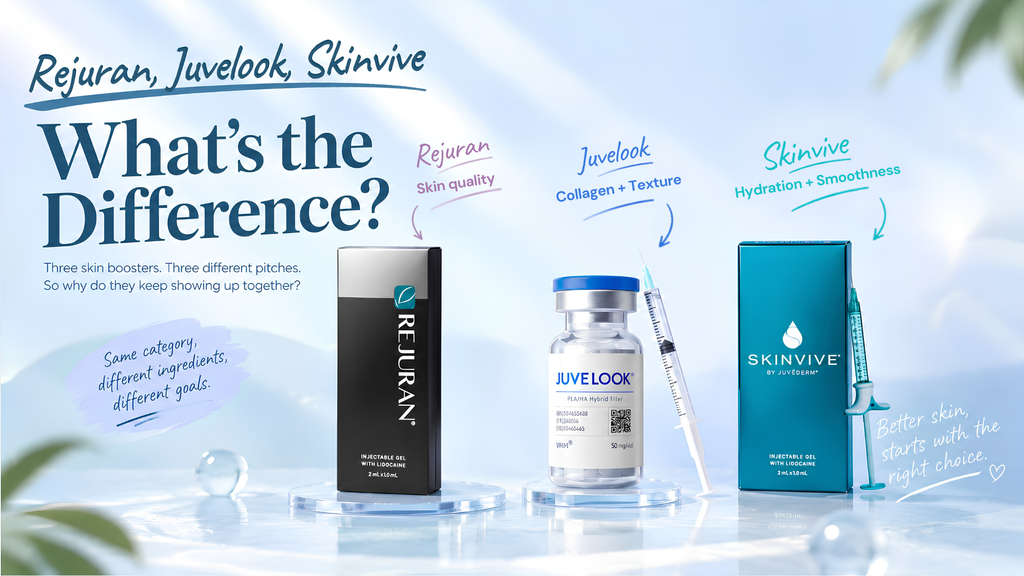
Three skin boosters. Three different pitches. So why do they keep showing up together?
Picture a Korean aesthetic clinic menu.
You came looking for better skin.
Then you see:
Rejuran.
Juvelook.
Skinvive.
You know they’re all talked about as skin boosters.
But that’s about where the certainty ends.
So let’s make things interesting.
Imagine the three treatments have been invited into the same room and asked one question:
“Why should someone choose you?”
First Up: Rejuran
Rejuran doesn’t rush to the microphone.
“I’m Rejuran.”
“I’m usually part of the conversation when someone isn’t looking for a completely different face.
They’re looking at their skin and thinking:
Why does it look tired?
Why does it feel drier?
Why are fine lines and texture suddenly more noticeable?
That’s where I come in.
My focus is skin quality.
My defining ingredient is polynucleotide, or PN, and I’m associated with a gradual approach to improving the condition and appearance of the skin.
I’m not promising a dramatic transformation overnight.
My pitch is simpler:
Make the skin look better, not the person look different.”
Rejuran steps away from the microphone.
Juvelook Has Something to Say
“That’s a nice speech.”
Juvelook walks up.
“But let’s talk about texture.”
“I’m Juvelook.
If pores, fine lines, uneven texture or loss of elasticity are what catch your attention in the mirror, my name may come up.
I combine PDLLA and HA.
The PDLLA side brings gradual collagen stimulation into the conversation, while HA contributes hydration.
So my approach is less about an instant visual makeover and more about gradual skin-quality improvement.
Think:
texture today → gradual change over time.
That’s my campaign.”
Rejuran looks over.
“You really like talking about collagen.”
Juvelook smiles.
“It’s part of my appeal.”
Skinvive Finally Speaks
Skinvive has been waiting patiently.
“Can I go now?”
“I’m Skinvive.
My story is actually pretty straightforward.
Sometimes people don’t want to change their face.
They don’t even have a complicated list of concerns.
They simply want their skin to look:
more hydrated.
smoother.
fresher.
I’m an HA-based injectable treatment delivered as tiny intradermal microdroplets.
In the U.S., my FDA-approved indication is specifically for improving cheek skin smoothness in adults.
So if your complaint is:
‘My cheeks don’t look as smooth as I’d like.’
I’m listening.”
Wait. Aren’t They All Skin Boosters?
Yes.
But “skin booster” is the category, not the treatment.
That’s the first thing worth remembering.
The three candidates may appear next to each other on a Korean aesthetic menu, but their ingredients and treatment concepts aren’t identical.
The 30-second version
So if someone tells you:
“They’re all basically the same.”
Not quite.
And if someone tells you:
“One is automatically better than the others.”
That’s oversimplifying it too.
Rejuran vs Juvelook: Aren’t They the Closest?
Probably the comparison you’re most likely to encounter when researching Korean skin treatments.
Both can enter conversations about skin quality, texture and signs of ageing, but their formulas are different.
Rejuran
PN-based.
Its identity is strongly associated with polynucleotides and a skin-quality-focused approach.
Juvelook
PDLLA + HA.
Its PDLLA component brings gradual collagen stimulation into the treatment concept, while HA contributes hydration.
So the simplest distinction is:
Rejuran puts PN at the centre of the conversation. Juvelook brings PDLLA + HA.
That difference matters when a specialist is matching a treatment to someone’s specific skin concerns.
Juvelook vs Skinvive: Collagen or Hydration?
This comparison becomes easier once you stop thinking about the brand names.
Juvelook
The conversation includes PDLLA, gradual collagen stimulation, texture and elasticity, alongside HA.
Skinvive
The conversation is much more specifically about HA, hydration and cheek skin smoothness.
So:
Juvelook has a collagen-stimulation angle. Skinvive has a hydration-and-smoothness angle.
They’re not simply two brands doing exactly the same thing.
Rejuran vs Skinvive: Skin Quality or Hydration?
This is another easy one to confuse.
Rejuran
PN is the defining ingredient, with the treatment commonly discussed in the context of overall skin quality.
Skinvive
HA is the key ingredient, with its U.S. FDA-approved indication focused on cheek skin smoothness.
So:
Rejuran is PN-focused, while Skinvive is HA-focused and specifically positioned around cheek skin smoothness and hydration.
Different ingredients.
Different treatment concepts.
Different conversations.
Now Forget the Brand Names for a Minute
This is where choosing a skin booster becomes much easier.
Imagine your skin could talk.
“My skin looks tired and feels dry.”
You may start exploring a skin-quality-focused treatment such as Rejuran, or other options depending on what the specialist sees.
“My pores and texture are bothering me.”
Juvelook may enter the conversation because of its PDLLA + HA formulation and collagen-stimulation angle.
“My cheeks just don’t look as smooth and hydrated.”
That’s much closer to Skinvive’s specific positioning.
“I have a little bit of everything.”
Welcome to the difficult category.
Because skin concerns rarely arrive one at a time.
You might have dryness and fine lines.
Texture and reduced elasticity.
Pores and dullness.
That’s why choosing a treatment purely because you’ve seen it trending online isn’t necessarily the end of the decision.
It’s the beginning of the conversation.
Why Are These Treatments So Popular in Korean Aesthetic Conversations?
There’s a noticeable difference between:
“I want to change my face.”
and:
“I want my skin to look better.”
The second goal has become a much bigger part of aesthetic conversations.
Instead of focusing only on facial shape, people are paying closer attention to:
- Skin texture
- Hydration
- Fine lines
- Elasticity
- Smoothness
- Overall skin quality
And that fits the appeal of treatments such as Rejuran, Juvelook and Skinvive.
For someone travelling to Korea, the attraction may not be the idea of coming home looking obviously “done.”
It can be the opposite:
Looking like yourself, just with better-looking skin.
One More Thing: Don’t Choose From the Menu First
This is where first-time aesthetic travellers can get stuck.
You research for an hour.
You decide:
“I want Rejuran.”
Then the clinic consultation starts.
And suddenly you’re discussing your actual skin concerns, treatment area, formulation and expected results.
That’s why it’s often more useful to arrive with a goal rather than a fixed product name.
Instead of:
“I want Juvelook.”
Try starting with:
“I’m mainly concerned about my skin texture and fine lines. What treatment options should I discuss?”
That leaves room for the specialist to assess your skin and explain which options may be appropriate.
So… Who Wins the Skin Booster Election?
Rejuran?
Juvelook?
Skinvive?
The answer was never really about finding one champion.
Because they aren’t identical candidates competing for exactly the same job.
Rejuran:
PN and a skin-quality-focused approach.
Juvelook:
PDLLA + HA, with a gradual collagen-stimulation angle.
Skinvive:
HA, with a focus on hydration and cheek skin smoothness.
Three names.
Three different approaches.
And one much more useful question:
Not “Which one is the best?”
But “What exactly do I want my skin to improve?”
Once you know that, the treatment menu starts looking a lot less confusing.
And that’s probably a better place to begin your Korean aesthetic journey than simply voting for whichever name happens to be trending.