
Lumps and Bumps After Liposuction: What Is Normal Swelling and What Requires Attention?
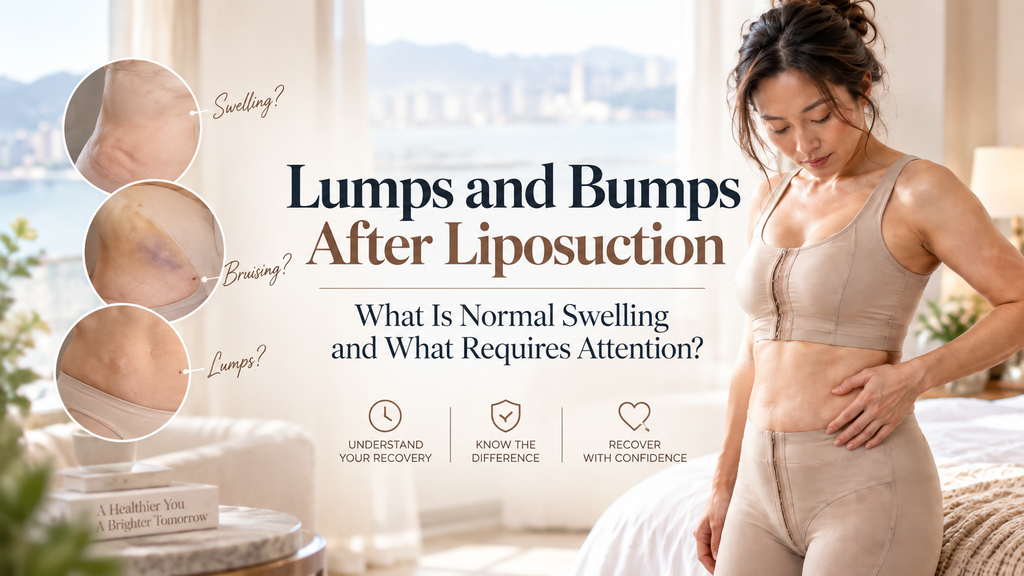
The Post-Liposuction Phase Nobody Puts in the Before-and-After
The suitcase is packed.
The hotel is booked.
The procedure is over.
Then your body decides to become a little unpredictable.
A patch feels hard.
A section looks swollen.
One side seems different from the other.
Your clothes feel strange.
And suddenly, the thing you thought would be the easiest part, waiting for your body to heal, becomes the part with the most questions.
This is the awkward middle of liposuction recovery.
It isn’t the procedure anymore.
It isn’t the final result either.
It’s the stretch in between, when your body is healing but doesn’t yet look or feel like the version you’re waiting for.
And because there isn’t a neat label attached to every lump, bruise or strange sensation, knowing what to ignore, what to monitor and what deserves a call becomes important.
Here are some of the things nobody puts in the glossy before-and-after.
1. Your Body Can Temporarily Look Like It Went in the Wrong Direction
Let’s start with the most confusing one.
An area treated to become smaller can temporarily look bigger.
It sounds almost ridiculous.
But swelling and bruising after liposuction can make the treated area appear fuller, puffier or less defined during the early stages of recovery.
So if you were expecting an immediate visual reveal, the first few days may feel underwhelming or even backwards.
That’s because the body has two things happening at once:
The procedure has changed the underlying fat distribution.
The body is responding to the procedure by healing.
The mirror sees the second part very clearly.
The first part may take longer to appreciate.
What this means
An early swollen appearance does not necessarily tell you what the final contour will look like.
It is one reason judging the result too soon can create unnecessary anxiety.
2. “Lumpy” Doesn’t Tell You Enough
The word itself sounds alarming.
Lump.
It suggests something solid, wrong or unexpected.
But after liposuction, people may notice areas that feel firm, swollen or uneven while tissues are healing.
That doesn’t automatically mean there is a complication.
At the same time, assuming every lump is harmless isn’t the answer either.
The useful question is not simply:
“Is there a lump?”
It’s:
“What is the lump doing?”
Is the area changing as your recovery progresses?
Is the discomfort settling?
Does it fit what your treating team explained?
Or is there a new or worsening change that concerns you?
The word lump is only one clue.
The pattern is more useful.
3. Your Left Side May Apparently Have Its Own Schedule
There is a surprisingly human moment during recovery:
You check one side.
Then the other.
They’re not identical.
You check again.
Still different.
This can be unsettling, particularly if you are looking closely at your body every day.
But recovery does not necessarily happen in perfect symmetry.
Swelling and other healing changes can settle at different rates, so temporary differences between sides can occur.
That doesn’t mean every asymmetry should simply be dismissed.
It means that early symmetry is not a reliable shortcut to judging the final contour.
And this is exactly why comparing your recovery with somebody else’s photographs can create more confusion than clarity.
Their day 7 is not your day 7.
Their procedure isn’t necessarily your procedure.
Their body isn’t yours.
Their recovery isn’t yours.
4. Your Fingers May Notice Things the Camera Can’t
Before-and-after photographs show shape.
They don’t show texture.
They don’t show tenderness.
They don’t show whether an area feels tight, numb, sensitive or firm.
During recovery, the treated area can feel unfamiliar even when there isn’t much dramatic to see.
You might notice:
- tightness
- tenderness
- temporary numbness
- increased sensitivity
- firmness
- an uneven texture
This can make recovery feel more complicated than it looks.
And because everyone experiences healing differently, your treating medical team’s instructions matter more than somebody else’s recovery story online.
If a sensation is severe, worsening or significantly different from what you were told to expect, that’s something to discuss with the medical team responsible for your care.
5. The Compression Garment Can Become the Main Character
Nobody puts this in the before-and-after.
The compression garment does.
Depending on your treatment and your medical team’s instructions, you may be asked to wear compression garments during part of your recovery.
Suddenly, clothes become a practical problem.
What can you comfortably wear?
What fits?
What can you wear to work?
What can you wear through an airport?
Can you sit comfortably at dinner?
These questions sound small until you’re actually recovering.
This is also why downtime isn’t simply a number of days.
Being mobile doesn’t necessarily mean you feel ready to dress normally, attend social events or return to every part of your routine.
Your treating team can advise you about activity and recovery based on your individual procedure.
6. Then Comes the “Can Anyone Tell?” Problem
You know exactly what happened to your body.
Other people don’t.
That creates a strange situation.
You may be very aware of swelling, bruising or compression garments while everyone around you is simply having a normal day.
Sometimes nobody notices.
Sometimes recovery is more visible.
Either way, the question can matter if you have work, meetings, dinners or events planned soon after treatment.
This is especially worth thinking about when travelling for liposuction.
A treatment itinerary might look perfectly simple:
Procedure → hotel → airport → home.
Recovery may not be quite that tidy.
7. The Internet Has a Completely Different Recovery Timeline
Someone says their swelling disappeared in a week.
Someone else says they were still swollen much later.
Another person posts a photograph that looks almost nothing like yours.
Now you’re wondering whether your recovery is normal.
This is where the internet can accidentally turn recovery into a competition.
Who looked normal first?
Whose swelling disappeared fastest?
Whose body looked better at day 10?
None of those comparisons can tell you whether your recovery is progressing appropriately.
Online experiences can help you understand the range of things people may experience.
They cannot assess your individual recovery.
So if you’re concerned about a particular change, use the internet for context, not diagnosis.
8. The Important Question Isn’t “Does It Look Weird?”
This is where recovery gets more practical.
Bodies can look weird during healing.
That, by itself, isn’t a useful medical test.
Instead, think about change.
A change that fits the recovery instructions given by your treating team may simply need time and observation.
A change that is unexpected, significant or getting worse deserves a conversation with the medical team.
Some symptoms require prompt medical attention, including:
- significant or worsening pain
- rapidly increasing swelling
- fever
- unusual drainage
- breathing difficulty
- chest pain
These aren’t symptoms to watch indefinitely at home.
Your treating team should also give you specific post-procedure instructions, and those instructions take priority because they relate to your actual procedure and recovery.
The Three-Word Recovery Rule
When something looks strange, resist the urge to immediately label it.
Instead:
Wait. Watch. Call.
WAIT
If the change fits what your medical team told you to expect, your body may simply need more time.
WATCH
Pay attention to how the area develops rather than judging it from one photograph or one morning.
CALL
If something concerns you, particularly if it is worsening or doesn’t match your recovery instructions, contact your treating medical team.
This isn’t about becoming your own medical detective.
It’s about knowing when time is part of recovery and when professional assessment is the better next step.
And Then There Is the Most Annoying Part: Waiting
You can follow every instruction perfectly and still have to wait.
The swelling doesn’t disappear because you are impatient.
The firmness doesn’t necessarily disappear because you keep checking it.
The final contour doesn’t arrive simply because you have an important event next weekend.
Healing has its own timetable.
That can be frustrating because liposuction is a procedure with a very visible goal.
You want to see the change.
But the body has to work through the recovery before that change becomes easier to judge.
The middle can be messy without being the ending.
If You’re Recovering in Another Country, Don’t Plan Only the Procedure
For international clients, there is another layer to this awkward middle.
You’re not necessarily recovering in your own home.
You may be staying in a hotel, travelling between your accommodation and a clinic or hospital, arranging follow-up and eventually planning your journey home.
That makes recovery logistics worth discussing before treatment.
Not just:
“What procedure am I having?”
But also:
“Where will I stay?”
“How will I get to follow-up?”
“How long should I allow for recovery?”
“Who do I contact if something concerns me?”
“When should I plan my journey home?”
BeautsGO helps international clients coordinate consultations with clinics and hospitals, understand treatment options and estimated costs before commitment, and navigate practical parts of the journey such as accommodation guidance, transfers and follow-up coordination.
Because travelling for treatment shouldn’t mean figuring out the recovery plan after you’ve already arrived.
The Before-and-After Has a Missing Chapter
Most liposuction content shows two moments:
Before.
After.
But there is an entire chapter between them.
The swelling.
The bruising.
The strange textures.
The uneven days.
The uncomfortable clothes.
The questions.
The waiting.
And the occasional moment when you wonder whether what you’re seeing is simply recovery or something worth discussing.
That chapter may not be glamorous enough for a before-and-after photograph.
But it is part of the real experience.
And knowing what that middle can look like makes it easier to approach recovery with realistic expectations.
So if you notice a lump, swelling or an uneven area after liposuction, don’t judge the entire result from that single moment.
Look at the change. Follow your recovery instructions. And when something genuinely concerns you, let the medical team responsible for your care interpret the clue.
The final result has a chapter of its own.