
Why Won’t My Acne Scars Fade? Here’s What’s Going On
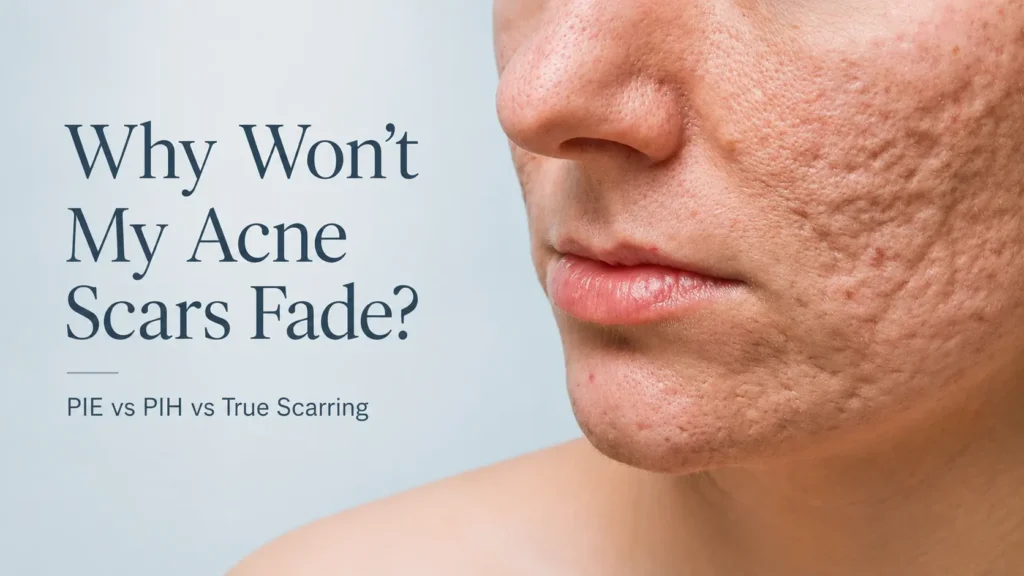
Most “acne scars” people worry about aren’t actually scars. Two very common marks left behind after a breakout, PIE (a flat red mark) and PIH (a flat brown mark), are temporary and fade on their own. True acne scarring is different: it’s an actual change in your skin’s texture that doesn’t resolve the same way. Telling these apart is the difference between waiting it out and needing treatment.
Quick Self-Check: Is It a Mark or a Real Scar?
- Flat and red or pink? → Likely PIE
- Flat and darker than the skin around it? → Likely PIH
- Indented, or the texture feels different, even if the color has faded? → Likely true scarring
If you’re seeing more than one of these at once, that’s common too, and it’s covered further down.
What Is PIE (Post-Inflammatory Erythema)?
PIE is a flat red or pink mark left behind after a pimple heals. It’s caused by small blood vessels near the surface of your skin staying dilated after the inflammation clears, not by any lasting damage to the skin itself.
It tends to fade on its own over a period of weeks to months. It’s usually more noticeable on lighter skin tones, since it’s really about blood vessel visibility through the skin, and sun exposure can make it look redder and stick around longer.
What Is PIH (Post-Inflammatory Hyperpigmentation)?
PIH is a flat brown or dark mark that forms when a breakout triggers extra melanin production in that exact spot. Like the red mark (PIE), it’s a pigment issue, not a change in your skin’s texture.
PIH is more pronounced and slower to fade in darker skin tones, and it can take considerably longer to resolve than PIE, especially without consistent sun protection on the area. It does tend to fade with time, just more slowly than most people expect.
What Is True Acne Scarring?
True acne scarring is an actual change in your skin’s texture, usually a small indentation, caused by damaged collagen while a deep or inflamed breakout was healing.
This is why it behaves so differently from the red and dark marks above (PIE and PIH): it isn’t about color or blood vessels, it’s a structural change in the skin. That’s also why it doesn’t fade the way a mark does, waiting longer doesn’t resolve a texture change the way it resolves a pigment change. There are a few different shapes of true acne scarring (some are narrow and deep, others are broader and shallower), which matters for treatment but isn’t necessary to sort out before you know whether you’re dealing with a mark or a real scar in the first place.
PIE vs. PIH vs. True Scarring: Side by Side
Swipe left to see all three columns
Can You Have More Than One at the Same Time?
Yes, this is common on acne-prone skin. You can have a red mark in one spot, a dark mark in another, and a texture change somewhere else, or even a red mark and a texture change layered on top of each other in the same spot. These are separate processes happening for different reasons, so having more than one doesn’t mean anything is unusual, it’s just how breakout-prone skin often heals.
How Long Should You Wait Before It’s Not Going to Fade on Its Own?
This is really the question behind “why won’t my acne scars fade.” The red mark (PIE) usually shows real improvement within a few months. The dark mark (PIH) takes longer, often six months to a year, and can take longer still without sun protection.
If it’s been well beyond that timeframe with no real change, or if what you’re looking at has any texture to it rather than being flat, that’s a sign it’s worth getting a professional opinion rather than continuing to wait. Waiting works for pigment, it doesn’t work for texture.
Not sure which one you’re dealing with?
Send a few photos and we’ll get a doctor’s initial read on whether what you have is likely to fade on its own. No appointment, no forms.
Message us with a photo