Why Is Your Scar Raised, Red, or Dark? Hypertrophic Scars, Keloids & Hyperpigmentation, Explained
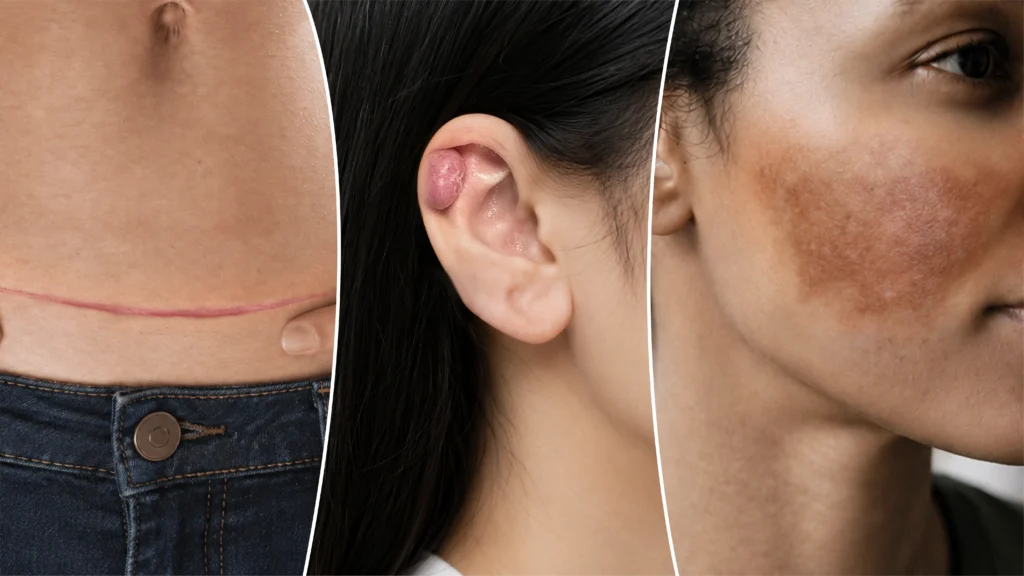
A raised, red scar is often a hypertrophic scar: it stays within the original wound and usually fades over time. A raised scar that keeps growing beyond the wound edge is more likely a keloid. A flat, darkened patch that isn’t raised at all is usually post-inflammatory hyperpigmentation (PIH), a pigment issue, not scar tissue. Here’s how to tell which one you have, and what typically happens next.
The Quick Self-Check: Match Your Scar to These 3 Signs
Before reading the full breakdown, run through this:
- Raised, red, and staying inside the original wound line? → Likely a hypertrophic scar
- Raised and spreading beyond where the original cut or wound was? → Likely a keloid
- Flat, but darker than your surrounding skin? → Likely post-inflammatory hyperpigmentation (PIH)
If your scar checks more than one box (for example, raised and darker than your skin tone), that’s common too, and it’s covered further down.
What Is a Hypertrophic Scar?
A hypertrophic scar is a raised, pink-to-red scar that stays within the boundaries of the original wound and typically flattens and fades within 1–2 years.
It forms when the body produces extra collagen during healing, often at wound sites under tension: think joints, the chest, or areas that stretch when you move. It can feel itchy or slightly tender in the first few months, which is normal as the scar remodels.
Unlike a keloid, a hypertrophic scar doesn’t cross over into surrounding, uninjured skin. That boundary is the single most useful thing to check if you’re trying to tell the two apart at home.
What Is a Keloid?
A keloid is a raised scar that grows beyond the edges of the original wound and doesn’t shrink on its own. It can keep expanding for months or even years after the injury has healed.
Keloids show up most often on the earlobes (frequently after piercing), chest, shoulders, upper back, and jawline. They’re more common in people with darker skin tones and in those with a family history of keloids, though anyone can develop one.
Because keloids don’t resolve without intervention, they tend to need active management rather than a “wait and see” approach, especially if one is growing, painful, or restricting movement near a joint.
What Is Post-Inflammatory Hyperpigmentation (PIH)?
PIH is a flat, darkened patch of skin caused by extra melanin production after inflammation or injury. It’s a pigment change, not scar tissue, and it isn’t raised.
It can follow almost any skin trauma: a healed cut, a burn, acne, or even a hypertrophic scar or keloid as it settles. It’s more pronounced and slower to fade in darker skin tones, and sun exposure on the area can make it darker and last longer.
Because PIH is about pigment, not texture, it responds to different treatments than a raised scar does, which is why getting the type right matters before choosing how to treat it.
Hypertrophic Scar vs. Keloid vs. Hyperpigmentation: Side-by-Side
Swipe left to see all three columns
Can You Have More Than One at the Same Time?
Yes, a scar can be both raised (hypertrophic or keloid) and darker than your skin tone (PIH) at the same time, since texture and pigment are separate healing processes that can overlap.
This is why a scar can look “worse” over time even as the raised part is flattening: the texture may be improving while the pigment is still settling in. Both usually need to be addressed, but not necessarily with the same treatment.
When Should You See a Specialist?
Most scars are safe to simply monitor, but get a professional opinion if you notice any of the following:
- The scar keeps growing months after the wound healed
- It’s painful, itchy enough to disrupt sleep, or restricts movement
- It’s on a visible area and not improving after 6+ months
- You’re not sure whether it’s a keloid, since early keloids and hypertrophic scars can look similar
Not sure if it’s worth seeing someone?
Send a few photos of your scar and we’ll get you a dermatologist’s initial read. No appointment, no forms.
Message us with a photoHow Are They Treated Differently?
- Hypertrophic scars often respond to silicone sheets/gel, pressure therapy, or steroid injections to speed up flattening.
- Keloids usually need a more active approach: steroid injections, surgical removal (often combined with another treatment to prevent regrowth), or laser therapy.
- Hyperpigmentation is treated with topical brightening agents, chemical peels, or laser, plus consistent sun protection, since texture treatments won’t fade pigment on their own.
Want to know what treatment could look like for your type?
See your treatment optionsPrefer the short version? Send a photo and we’ll get a doctor’s initial take on where to start. Message us with a photo