
Fixing a Past Liposuction: How to Correct Uneven Results or Bumpy Skin
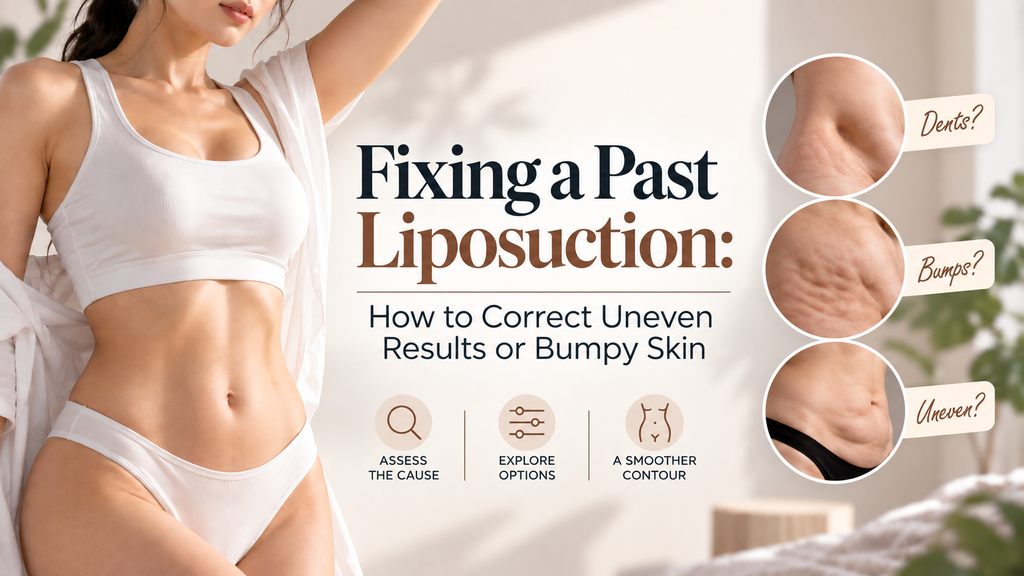
Case File: The Fat Is Gone. The Shape Isn’t Right.
Complaint received:
“I don’t like my liposuction result.”
Evidence:
A dent.
A bump.
One side looks fuller.
The skin doesn’t look as smooth as expected.
First theory:
“Too much fat was removed.”
Second theory:
“Not enough fat was removed.”
Problem:
Either theory could be wrong.
When a previous liposuction result doesn’t look the way you expected, the visible problem isn’t always the actual problem.
And that is why revision can be more complicated than simply going back and saying:
“Can you take a little more out?”
So let’s investigate.
Clue #1: When Did the Problem First Appear?
Before calling the case “finished,” check the timeline.
If you recently had liposuction, your body may still be changing. Swelling, firmness and differences between areas can affect the way the contour looks while healing.
Something that looks uneven early on may not stay that way.
That doesn’t mean every concern should simply be ignored and forgotten.
It means timing is part of the evidence.
If the area continues to change, it may be too early to judge the final contour.
If the area has had enough time to settle and the same concern remains, the investigation moves to the next clue.
What exactly are you seeing?
Clue #2: Identify the “Suspect”
“Uneven” is a very broad description.
Let’s make it more specific.
Exhibit A: The Bulge
You look at the area and think:
“There’s still fat there.”
Perhaps there is.
But the important question is whether that fullness is actually the reason the overall contour looks uneven.
Removing more from one spot can change the relationship between that spot and everything around it.
So the question isn’t simply:
“Can more fat be removed?”
Adalah
“Would removing more actually improve the shape?”
Exhibit B: The Dent
This one can be particularly frustrating.
You wanted less fullness.
Instead, you’re left with an area that appears sunken.
Your first thought might be:
“They removed too much.”
That may be part of the explanation, but the useful question now is different:
“How does the surrounding contour look, and what tissue is available for improvement?”
In some situations, correction may involve restoring volume rather than removing more.
Exhibit C: The Waves and Ripples
The area is slimmer, but the surface doesn’t look smooth.
Maybe the irregularity is barely noticeable in one position but obvious when you move or stand under certain lighting.
This is where photographs can sometimes make the problem look simpler than it really is.
A specialist may need to consider the underlying contour and tissue distribution rather than looking only at the surface.
Exhibit D: The Two Sides Don’t Match
One side appears fuller.
The other looks flatter.
You immediately think:
“One side must have been done differently.”
Maybe.
But bodies aren’t perfectly symmetrical to begin with.
The useful question is whether the difference is part of your natural anatomy, related to healing, or associated with the previous contouring.
That distinction matters before deciding what should happen next.
Exhibit E: The Skin Is Now the Main Character
You thought the problem was fat.
But the fat has been reduced, and the area still doesn’t look the way you wanted.
Now the skin becomes part of the investigation.
If loose or less-tight skin is contributing to the appearance, removing additional fat may not solve the concern.
The thing you keep staring at in the mirror may not be the thing that needs more treatment.
Clue #3: The “More Liposuction” Theory
This is where many people naturally go first.
“There is still a problem. Just remove more.”
Terdengar logis.
But revision doesn’t always work that way.
Think about a pair of jeans that has been altered.
If one section is already too narrow, making it narrower again won’t necessarily make the whole pair fit better.
Liposuction revision can involve the same basic problem of proportion.
Taking away more from one area can sometimes help.
But if another area is hollow, uneven or lacking volume, more removal may not address the real issue.
Depending on what a specialist finds, improving a previous contour may involve removing remaining fat, restoring volume, considering the skin, or combining approaches.
The important point isn’t which procedure sounds most impressive.
It’s whether the approach makes sense for the shape you have now.
Clue #4: The Original Procedure Still Matters
A revision doesn’t begin with a blank canvas.
The previous liposuction has already changed the treated area.
That is why the original procedure becomes part of the case history.
If you have them, keep:
- Your original treatment date
- The areas that were treated
- Procedure details
- Before-and-after photographs
- Recovery information
- Any records from the original clinic or hospital
Even old photographs can be useful.
They help show where you started, what changed and what you’re concerned about now.
And if you don’t have all of this?
Don’t panic.
You can still explain what happened from your own perspective.
“This is how it looked before.”
“This is when I noticed the change.”
“This is what bothers me now.”
That’s already useful information.
Clue #5: What If It’s Been Years?
Here’s another assumption worth questioning:
“It’s been too long. There’s nothing I can do now.”
Time passing doesn’t automatically mean that a previous result cannot be assessed.
But a specialist is now looking at your current contour, not a fresh postoperative result.
That means the conversation becomes less about what happened immediately after surgery and more about what remains today.
You may have lived with the result for months or even years before finally deciding:
“I want another opinion.”
Itu tidak masalah.
You don’t need to have made the decision immediately.
Clue #6: You Don’t Have to Know the Diagnosis
This is perhaps the most important clue of all.
You don’t need to look at your body and figure out:
“This is an over-resection contour defect.”
You don’t need to know whether the problem is fat, volume, skin or tissue.
You don’t even need to know whether you need revision liposuction.
Anda cukup katakan
“This isn’t what I expected, and this is what I don’t like.”
The specialist’s role is to assess the current result and explain what may be contributing to it.
That changes the conversation from:
“Which procedure should I book?”
ke:
“What are my realistic options?”
That’s a much better place to start.
Case Review: Can a Previous Liposuction Be Corrected?
Sometimes a previous result can be improved.
But “correction” doesn’t mean pressing a reset button and returning the body exactly to its pre-liposuction appearance.
The previous procedure has already changed the tissue.
So the aim is generally to work with the current anatomy and contour and determine what improvement may realistically be possible.
For one person, the concern may be remaining fullness.
For another, it may be a depression.
For another, skin laxity may be contributing.
For someone else, several factors may overlap.
That is why there is no universal “revision liposuction fix.”
And honestly, that’s useful to know.
Because it means you don’t have to diagnose yourself from a checklist.
The Second Opinion
Maybe the original surgeon is nearby.
Maybe they’re on the other side of the world.
Maybe you don’t feel comfortable returning to the same clinic.
Or maybe you simply want another specialist to look at the result before making any decision.
You can start with a second opinion.
For international clients, BeautsGO can help coordinate this process with clinics and hospitals across Asia Pacific.
You can share information about your previous liposuction and explain what concerns you now have. The case can then be coordinated with a specialist for assessment and discussion of potential options.
You can understand the proposed approach and estimated cost before deciding whether you want to proceed.
There is no need to decide on another procedure simply because you asked for an assessment.
Final Finding: Don’t Try to Fix the Wrong Problem
If you don’t like your previous liposuction result, your first instinct may be to search for the procedure that will “fix” it.
But that may be starting at the wrong end.
A bulge doesn’t automatically mean “remove more.”
A dent doesn’t automatically mean “the surgery failed.”
Uneven sides don’t automatically mean “one side needs more liposuction.”
Loose-looking skin doesn’t automatically mean “more fat needs to come out.”
And a recently treated area doesn’t automatically represent the final result.
The better starting point is much simpler:
What am I actually looking at?
Then:
Why might it look this way?
And finally:
What, if anything, can realistically be changed?
Your previous liposuction cannot simply be erased.
But if the result isn’t what you hoped for, you don’t have to guess what to do next.
Sometimes the most useful first step isn’t another procedure.
It’s getting the case properly reviewed.