
Best Country for Acne Scar Treatment: An Honest Comparison
Key takeaways
- No country wins outright. What decides it is how far you live from it, how routinely clinics there treat skin like yours, and cost, roughly in that order.
- Distance matters more than most people expect. A full course runs across months and cannot be compressed into one trip, so the real question is what happens across those months, not whether you can fly there once.
- Skin tone is a genuine difference and almost nobody discusses it. On skin with more melanin, the risk that matters is the treated area darkening afterward, and where that skin type is the everyday norm, cautious settings for it are the default rather than an adjustment.
- Published prices are not comparable. Some are per session, some per scar, some a full course. Ask every clinic for the price of the whole plan, and add the flights before you compare anything.
- Choose the doctor before the country. Picking a destination first limits your shortlist by a decision made before anyone had seen your skin.
Your shortlist depends on how far you can realistically travel, and on whether you can do it more than once. A reader in Jakarta and a reader in London should not be choosing between the same countries, because acne scar treatment is not a single appointment. A full course runs across months.
That one fact reorders everything else, including the things most people research first. What follows is what genuinely differs between the main options in Asia, in the order that actually matters, and the questions worth asking wherever you go. If you are still deciding what your scarring needs, start here. If you want to know how many trips this involves, that is covered here.
The Short Answer
If you can only travel once, and it is a long way, choose on how much can be done in a single visit. That points toward clinics that combine several procedures in one appointment, which is a well established approach in Korea in particular.
If you are within a short flight, choose the individual clinic rather than the country. Returning is easy, so the main constraint in this whole article mostly disappears, and comparing countries stops being the useful question.
If your skin is at the darker end of the range, weight that above both. It is the factor most likely to affect your result, and it is the one nobody puts in a country comparison.
Cost comes after all three for most people, because the gap between countries is usually smaller than the gap flights make. The rest of this article explains each of these, in that order.
Distance Matters More Than Technology
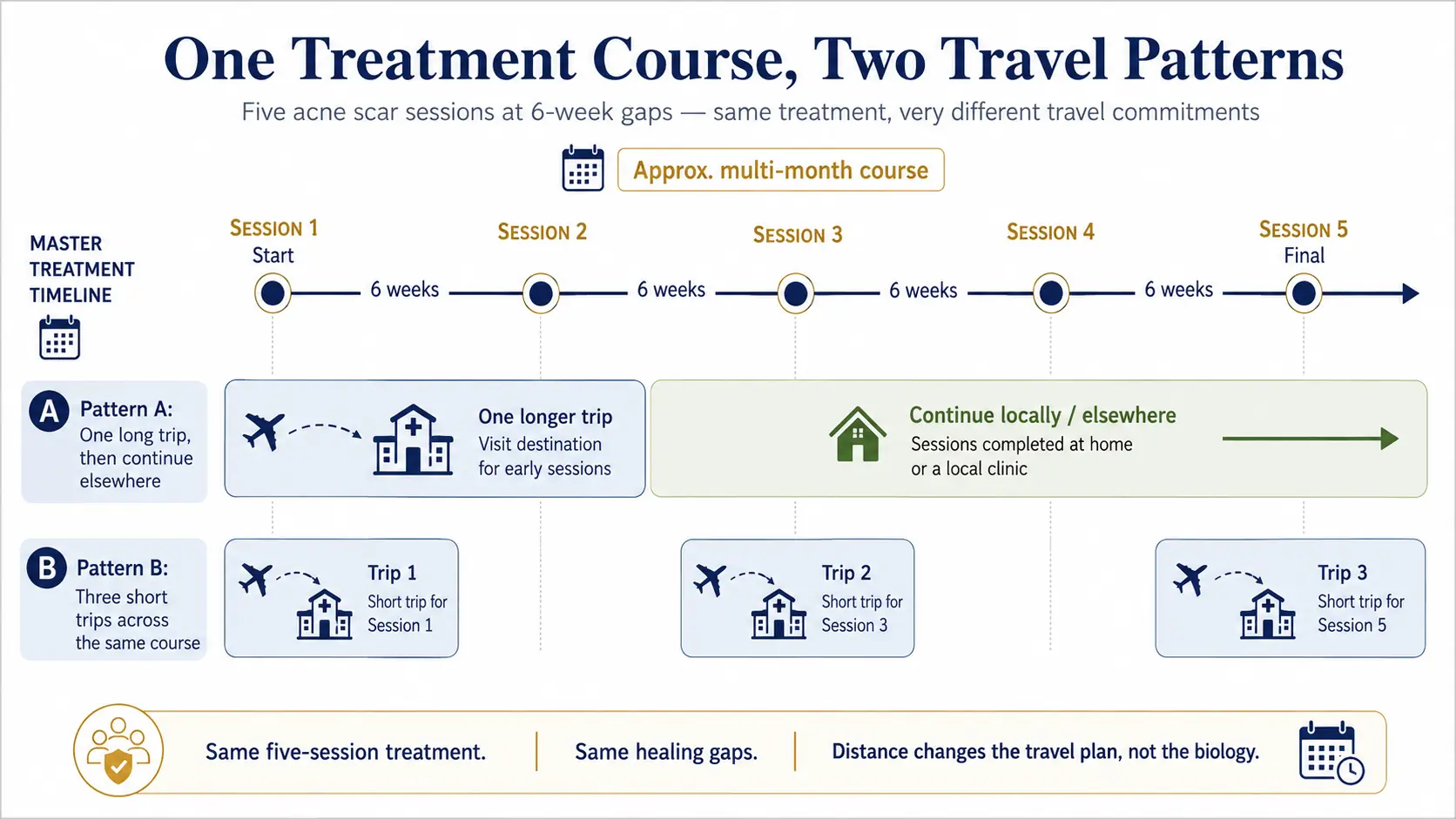
Published gaps between acne scar sessions run from about three to eight weeks, and a course of five or six sessions takes most of a year. The session guide covers why those gaps exist and cannot be shortened. The short version is that they are set by healing, not by scheduling.
So the real question is not “can I fly there once”. It is “what happens across the eight months this takes”. There are three honest answers, and which one is yours is mostly decided by how long the flight is.
One trip, front-loaded. Someone flying from London or Sydney will realistically come once. Procedures that can safely share an appointment are grouped into that visit, and the repeat resurfacing sessions are either dropped or continued at home. This is a real plan, not a compromise, but it needs to be designed that way from the start rather than discovered halfway through.
Several short trips. Someone in Jakarta, Ho Chi Minh City, or Manila is two or three hours from most of the options here. For them a return visit is a weekend, and a full staged course abroad becomes genuinely practical. This is the only one of the three that completes the whole plan in one place.
Start abroad, continue at home. The technical steps are done at the destination clinic, and the repeat sessions are done by a local doctor. This needs the first clinic to write out what was done in enough detail for someone else to continue it, which is a fair thing to confirm before you book rather than after.
What One Visit Can Actually Hold
This is worth knowing before you ask any clinic to design one, and it is also how you check that what you are offered is a real plan.
Releasing tethered scars, which clinics call subcision, and filling underneath them are commonly done in the same appointment, since a scar that has just been released is a reasonable candidate for something that keeps the space open. The filling is usually either hyaluronic acid filler, which shows a result immediately, or a collagen stimulator, which builds over weeks. Treating individual scars with a high-concentration acid, listed on most menus as TCA CROSS, can usually sit alongside both.
Many clinics add a resurfacing session to the same visit, either a fractional laser or radiofrequency microneedling, along with a supportive injectable such as PRP, exosomes, or one of the products marketed under names like Rejuran and Juvelook. That stack is where the layered protocols you see advertised come from. What each of these actually does, and which scars each one suits, is covered here, and two of the injectables are compared directly here.
What one visit cannot hold is repetition. A resurfacing course is several sessions spaced weeks apart, and a single trip buys one of those sessions, not the course. Punch excision is the harder limit, because it leaves stitched wounds, and resurfacing over that area waits weeks after the stitches are taken out. Those two do not fit into one short trip.
If You Already Live in the Region
If you are reading this from somewhere in Southeast Asia, most content on this subject was not written for you. It assumes a long-haul reader deciding on one big trip.
This is not a small group. Reporting on medical travel in the region puts the number of Indonesians seeking treatment abroad each year in the range of one to two million, and describes Indonesian patients as the largest single source of medical tourism revenue for both Malaysia and Singapore.
A two hour flight changes the whole calculation. The largest obstacle in this article, that a course runs across months and cannot be compressed into one trip, mostly disappears when going back is a weekend rather than a second major journey. Cost and skin type move up in importance. Which country has the deepest ecosystem moves down, because you are not committing everything to a single visit.
If that describes you, the honest advice is to stop optimising for which country is best in general, and choose from whatever is within a short flight on the strength of the individual clinic.
Skin Tone Is a Real Difference, and Almost Nobody Says So
This is the factor most likely to affect your result, and the one you will not find discussed in country comparison articles, because the clinics writing them have an obvious reason to avoid it.
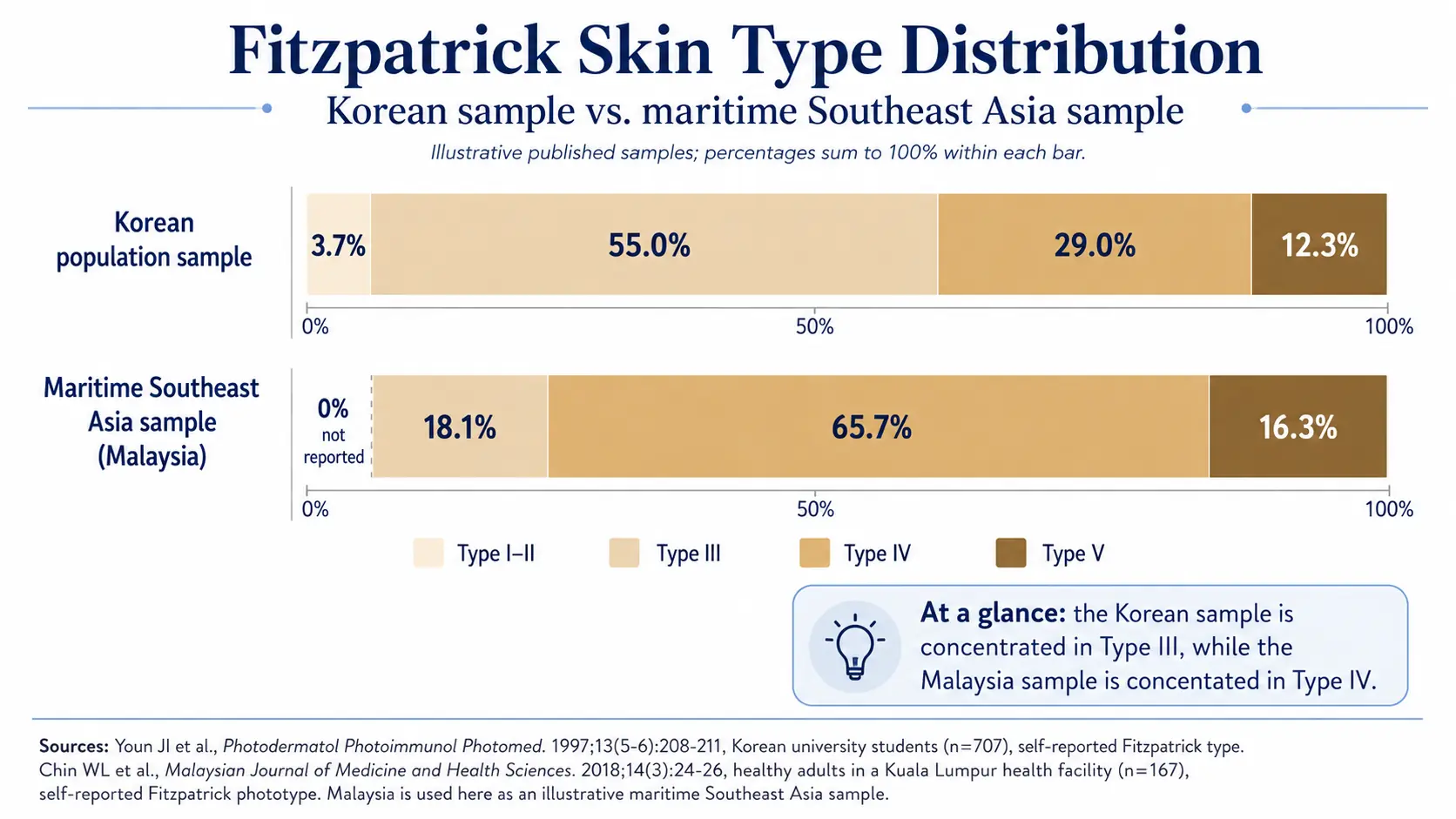
Start with the clinical fact. Skin with more melanin is more likely to darken at the treated area after a procedure, an effect called post-inflammatory hyperpigmentation. Published reviews describe this risk as rising with Fitzpatrick skin type, and describe it as a continuing limitation of fractional CO2 laser resurfacing for acne scars in types III to V specifically. The recognised response is lower energy settings, lower treatment density, and often longer gaps between sessions.
Now the part that differs by country. Population skin type is not evenly distributed across Asia. A study of Fitzpatrick types in Korean people reported type III at roughly 49 percent and type V at roughly 18 percent. Populations in Malaysia and across maritime Southeast Asia are commonly described in the dermatology literature as sitting in types IV and V.
What follows from that is narrow, and worth stating precisely, because the sloppy version of this argument is both wrong and unfair.
It does not mean doctors in one country are better than doctors in another. Skilled clinicians treating type V skin exist in every country listed here, and a busy Seoul clinic in a district full of international patients may see more of it than a quiet clinic anywhere else.
What it does mean is that in a clinic where most patients are types IV and V, conservative settings for that skin are the everyday default rather than an adjustment someone has to remember to make for you. If your skin is at the darker end, that is reasonable to weigh. And whichever country you choose, it turns into a question you should ask directly, which is in the checklist near the end of this article.
What the Cost Gap Actually Is
Here is the problem with comparing prices between countries, stated before any numbers, because it changes how you read them.
Clinics publish in different units. Some quote one session of one procedure. Some quote a full course. Some quote per scar. These are the kinds of figures currently published:
- Bangkok clinics list acne scar sessions from roughly 500 to 2,900 THB, and price TCA CROSS separately, in one case at about 900 THB per scar or 2,900 THB for a full face
- Malaysian clinics commonly list laser sessions between about RM800 and RM5,000, depending on the laser
- Korean clinics commonly list around US$200 to US$500 per session, with full programmes published in the region of US$2,200 to US$5,500
- Tokyo clinics list fractional laser for acne scars at roughly ¥30,000 to ¥80,000 per session
- Singapore clinics more often quote a full course by severity, in the region of S$1,800 to S$7,500
Read that list again and notice what it does not let you do. A price per scar, a price per session, and a price per course are three different things, and no arithmetic turns one into another. The apparent gap between the cheapest and most expensive entry here is partly a real difference in cost of care and partly an artefact of what each clinic chose to put on its website.
Two things matter more than the ranking.
Ask every clinic for the price of the full plan. Not a session. Per session pricing on a treatment that needs several rounds is the number most likely to mislead you, and it is the number most clinics lead with.
Add the flights before comparing anything. For a long-haul reader, three return trips can cost more than the entire difference between the cheapest and most expensive clinical quote on this list. A comparison that stops at the clinic fee is comparing the smaller half of the bill.
How Simple Do You Need It to Be
Underweighted until something goes wrong. Three things to check, and all three are quick.
Language. Singapore and Malaysia are the straightforward cases. Thailand has a well established layer of clinics working with international patients. In Japan, English-speaking dermatology exists but sits in a small number of mostly Tokyo clinics, so confirm rather than assume. In Korea it varies widely, and a clinic used to international patients is a different proposition from one that is not.
Records you can take with you. This matters more here than for a one-off procedure, because someone else may continue the course. Ask whether you will get a written record of the device, the settings, and the number of passes. A clinic that finds the request normal is telling you something useful.
Who you contact afterward. If the treated area darkens, it usually happens weeks later, when you are home. Ask who reviews it and how.
The Countries, Side by Side
These figures are what clinics and listing sites publish, in the units they publish them in. They are a sense of scale, not a quote.
What Matters Less Than You Would Expect
Device brand names. Clinics market specific machines heavily, and the names travel: Fraxel, Potenza, Infini, Sylfirm, Picosure. Knowing them is useful for reading a clinic menu, and that is about the extent of it. What changes your result is the setting, the density, and the number of passes chosen for your skin, and those are decisions a clinician makes, not properties of the machine.
Having the newest technology. A newer device is not automatically better for an indented scar, and the procedures with the longest track record for the hardest scar types are not the newest ones.
A country’s general reputation for cosmetic work. A country known for cosmetic surgery is not automatically strong at acne scarring, which sits in a different specialty, with different equipment and a different kind of experience behind it.
What to Ask, Wherever You Choose
This is deliberately short and specific to acne scars and to treating abroad. Checking a clinician’s credentials and specialty is a separate question, and a general one, so it is not repeated here.
Each one comes with a note on how to read the answer, because a question you cannot score is not much use.
How will the settings be adjusted for my skin tone, and how often do you treat skin like mine? A useful answer names the adjustment: lower energy or density, longer gaps between sessions, a small test area first, or pigment control before and after. An answer made only of reassurance is not an answer.
Which parts of this plan can be done during my stay, and which cannot? You want a specific split, not “we will decide once you arrive”. A clinic that plans around travel routinely will already have a view on this before you ask.
Will I get a written record of the device, settings, and number of passes for each session? The answer you want is a plain yes. Hesitation here usually means it is not standard practice, which matters if anyone else continues your course.
If the treated area darkens after I fly home, who do I contact and how? A good answer names a person or a channel and a rough timeframe. “Just message the clinic” is weaker than it sounds once you are in another time zone.
Can you quote the full course rather than a per session price? A clinic that can only price per session either has not planned a course or does not want to show you the total.
If I complete only part of the plan, which stopping points leave things in a reasonable state? This one is partly a test. A clinic that answers it honestly is one that has thought about you not finishing, which is the opposite of a clinic selling you a whole package before you start.
Six good questions, and nobody to ask them yet.
That is the part we can do for you. Send us a few photos, and a partner doctor gives an initial opinion on what your scarring is likely to involve. From there we can put those questions to clinics in more than one country and bring you the answers, so you are comparing real replies rather than marketing pages.
Message us with a photo