
Is Medical Tourism Worth It? The Full Cost, Not the Quote

Key takeaways
- The saving is three lines, not one. Your quote at home, minus the quote from abroad, minus everything the trip costs. That third line is the only number that answers the question, and most people never write it down.
- Trip costs stay roughly the same whatever the procedure costs, so the saving has to cover them. A large procedure passes that test easily. A small one often does not, however good the percentage sounds.
- How far you live from the clinic changes the answer more than which clinic you pick. A flight of a few hours and a long-haul flight are different arithmetic, and almost everything written on this subject assumes the second one.
- A course of sessions does not fit into a trip. Ask whether your plan is one procedure or several appointments months apart before comparing any prices, and ask for the cost of the whole course rather than one session.
- The strongest reasons to travel are often not about price. Waiting time at home, a technique not offered near you, and how often a team performs your specific procedure are all more reliable than a headline discount.
You have seen a price that looks too good, and you cannot tell whether the difference is real or whether you are missing something. That is a reasonable place to be. The difference usually is real, and most people are also missing something, and those two facts are not in conflict.
This article is about the money and the time. It gives you three questions that show roughly where you stand, then the actual calculation, then the things that change the answer. Whether the care itself is safe is a separate question with a separate answer, and it is not covered here.
Three Questions That Answer Most of This
About a minute. For a lot of people these three settle it, and there is no reason to read two thousand words to learn something you could know now.
1. How large is the procedure? The saving is a share of the price, so a large operation carries a large difference in money and a small treatment carries a small one, however good the percentage sounds.
2. How long would the flight be? Two or three hours and a long-haul flight are different problems. This number decides more of the answer than anything medical does.
3. Is it one procedure, or a course of sessions? Ask the clinic directly. A single procedure fits into a trip. A course given over several months does not fit into a trip at all.
Now read your three answers together.
Small treatment, long flight, and a course of sessions. The answer is probably no. You have learned that in a minute rather than after paying a deposit, which is the cheapest possible moment to learn it.
Large procedure, short flight, one operation. The money almost certainly works. What is left to decide is who performs it and what happens afterwards, which is a different subject from this one.
Anything in between. This is where the rest of the article is useful, because the answer turns on numbers only you have.
The Whole Calculation Is Three Lines
Most people do the first line, stop there, and then argue about the result for weeks. All three lines take about ten minutes.
Line one. Your quote at home, minus the quote from abroad. This is the difference that made you start looking. It is a real number and it is not the answer.
Line two. Everything the trip costs. Flights, the nights of accommodation while you recover, a companion if you need one, your days away from work, medical travel insurance, and a realistic allowance for a second trip.
Line three. Line one minus line two. This is the real saving, and it is the only number that answers your question.
What line three tells you is unusually clear for a decision like this. If it is negative, staying at home is cheaper, whatever the headline price said. If it is small, you are taking on the distance and a recovery away from home for very little. If it is large, the money question is settled, and everything still to decide is about the hospital rather than the arithmetic.
The rest of this article is about line two, because line one is easy and line two is where the answer actually lives.
Why the Trip Cost Does Not Shrink With the Procedure
The cost of travelling is roughly the same whether you are having a small treatment or a major operation. The flight costs what it costs. The nights cost what they cost. The days away from work vary somewhat with recovery, but not nearly in proportion to the price of the procedure.
Line one behaves completely differently. It is a share of the procedure price, so it grows as the procedure gets bigger. A large operation carries a large difference in money. A small treatment carries a small one.
Put those two together and there is a point where they cross, which is the break-even point for your own trip. Below it the trip costs more than it saves and you are paying for the privilege of travelling. Above it the saving covers the trip and there is still a difference left over.
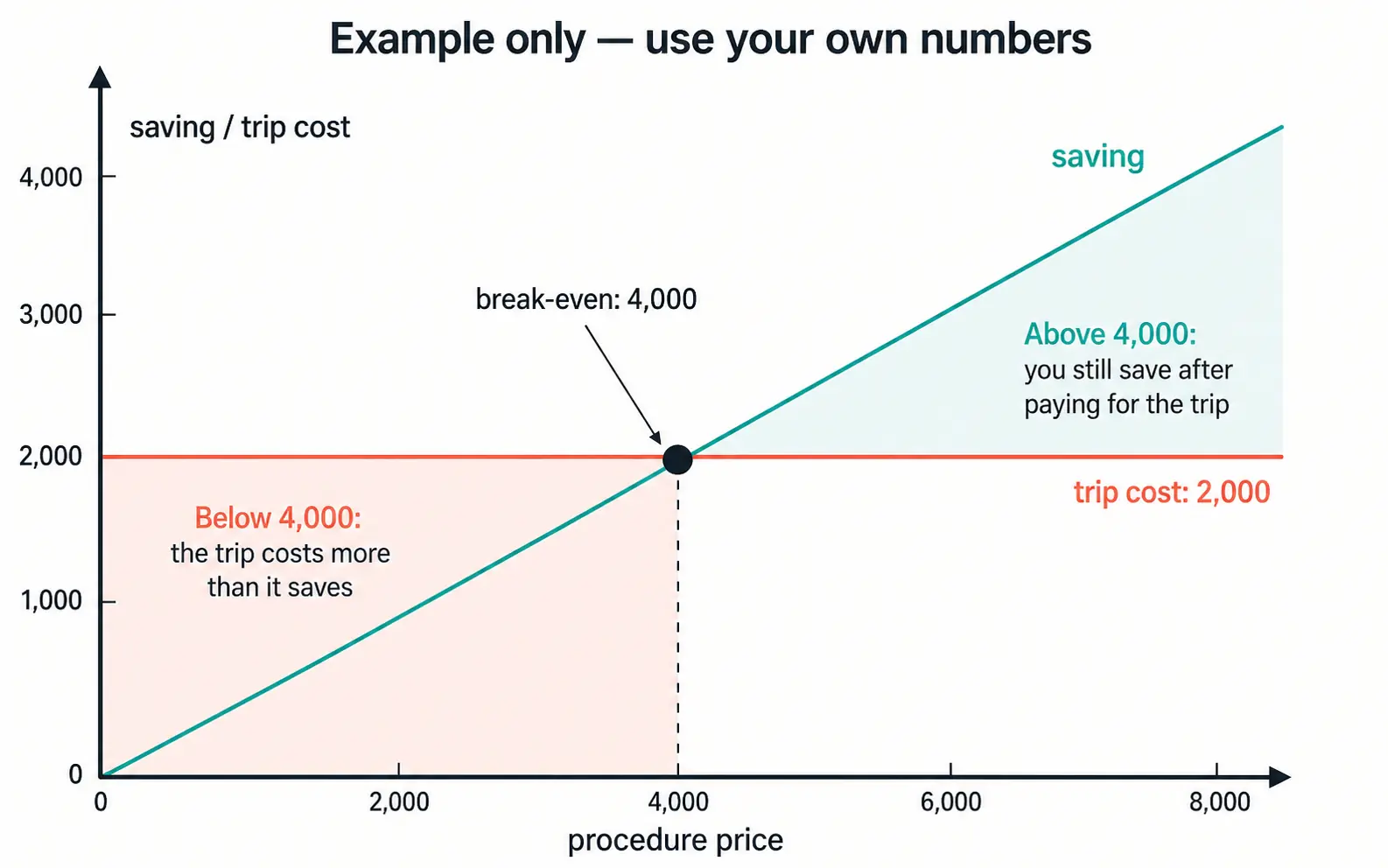
This is also why the figure you keep seeing does not help you. Writing on this subject repeats a saving of somewhere between 40 and 80 per cent, and that range tells you less than it appears to. It is a percentage of a procedure price that is not yours, in a country that may not be yours, and a large percentage of a small number is still a small number. The CDC’s own guidance on medical tourism states no savings figure at all.
What Goes Into the Second Line
Use the list below to build line two. Go through it against the quote you have actually been given, and mark the rows where you do not yet know the answer. Not knowing is normal at this stage, and seeing how many unknowns sit inside a number you were treating as settled is most of the value of the exercise.
What a quote includes differs between hospitals in the same city, so treat this as a list of questions rather than as a description of any one clinic.
Two of those rows usually decide the result, and both are easy to leave at zero without noticing.
Your days away from work cost you money even when no invoice arrives. If you are salaried with paid leave, you are spending leave you would have used for something else. If you are paid for the hours you work, the loss is direct. For many people this is larger than the flight.
The recovery accommodation is set by your body, not by your calendar. How many nights you need is a clinical decision made by the surgeon who operated. Booking the shortest plausible stay and hoping it is enough puts you in the position of choosing between a flight you have paid for and advice you have paid for.
Several rows on that list are questions only the hospital can answer.
Send us a few photos and whatever quote or plan you have already been given, and we will get a doctor’s initial read on it and tell you the parts that are missing: what a realistic stay looks like, and what the rest of line two totals. You pay the hospital directly and we do not add a markup, so the number you are comparing is the real one. Whether it is worth it is still your decision.
Message us with a photoCan a Price That Low Be Trusted?
This is the question sitting underneath the arithmetic, and it deserves a direct answer rather than a reassuring one.
Most of the difference has nothing to do with you. Salaries, the cost of buildings and land, insurance and administrative overheads, and how a country funds healthcare all differ enormously between countries, and those costs are most of what anyone is paying for. A procedure that costs several times more in one country is not several times more procedure.
There is a second reason, and this one does touch the care. Where a clinic performs one procedure at high volume, the fixed costs of doing it are spread across many patients. Specialisation lowers unit cost in medicine the same way it does elsewhere.
None of that tells you a particular price is trustworthy. A price can also be low because a step has been left out of it, and you cannot tell which by studying the number. You tell by asking what the number includes, which is the table above, and by asking who is performing the procedure. “Cheaper” is not a property of a country. It is a property of one quote from one hospital, and quotes differ inside the same city.
How Far You Live Changes the Answer More Than Which Clinic You Pick
Line two depends on one number that has nothing to do with medicine, and that is how long the flight is.
Someone in Jakarta, Singapore or Kuala Lumpur considering treatment in Bangkok or Seoul is looking at a flight of a few hours, a fare that is a fraction of a long-haul ticket, and a trip that can be taken over a long weekend without a formal leave request. Someone in London, Sydney or Toronto is looking at a different problem, with a much higher fixed cost before any medical decision is made.
That single difference moves the break-even point a long way. Procedures that cannot justify a trip from the other side of the world justify one easily from two hours away, and a reader who lives nearby can also do things a long-haul reader cannot, including returning for a follow-up visit or spreading a course of treatment across several short trips.
Almost nothing written about medical tourism is written for the second reader, because most of it is written for a North American audience. If you are already in Asia, you are not a smaller version of that reader. Your arithmetic is genuinely different, and it is different in your favour.
One Procedure Fits a Trip, a Course of Sessions Often Does Not
Some treatments happen once. Others work by prompting the body to rebuild something over time, and those are given as a course spread across months, with gaps between appointments that exist for biological reasons and cannot be compressed.
A single procedure fits into a trip. A course of several sessions, months apart, does not fit into a trip at all. It fits into a relationship with a clinic you can reach.
If your plan is a course, there are only a few honest ways forward. You can have it near home. You can have it abroad if you live close enough to return. You can start it abroad and finish it at home, with a clinician who agrees in advance to take that on rather than being asked once you are back. Or you can consider a different and usually more surgical plan that does fit into one visit, which is a real trade and worth making knowingly.
Ask which kind of plan you are being quoted before you price anything, and ask for the cost of the whole course rather than the cost of one session. A per session figure on a treatment that needs several rounds is the number most likely to mislead you.
The Reasons That Are Not About Price
Price is what makes people start looking, and it is often not what makes the trip worthwhile. Three other reasons appear repeatedly, and they survive examination better.
Waiting time. Where a procedure is available at home but the wait is measured in many months, the comparison is not really about money. It is between having the thing now and having it later, and the value of that depends on what the waiting is costing you.
A technique that is not offered near you. Availability is genuinely uneven. Some techniques are common in one country and rare in another, and for someone in a smaller city the nearest clinician doing a particular thing may already be a flight away. When the choice is between two flights, the international one competes on even terms.
Volume, for the specific thing you want done. How often a team performs your procedure is a reasonable thing to care about, and it is measurable in a way reputation is not. This is a claim about caseload, not about which country has better doctors. A busy clinic anywhere can see more of a given procedure than a quiet clinic in a country famous for it, which is exactly why the question to ask is about the individual team rather than the destination.
There is a fourth situation, which is that you are already travelling. If a trip is happening for other reasons, most of line two disappears and much smaller procedures start to make sense. One caution belongs with it. The CDC’s guidance warns that ordinary holiday activities during the period after a procedure, including alcohol, strenuous activity, sunbathing, swimming and long tours, can delay or impede healing. A trip that is a holiday and a trip that includes a procedure are not the same trip, whatever the marketing for all-inclusive surgery holidays suggests, and the recovery days have to be planned as recovery.
When the Honest Answer Is No
There is a version of this article that ends by saying it depends on your situation and leaves you where you started. Here are the situations where the answer is reasonably clear.
When line three is negative or narrow. Travelling is then not the cheaper option, whatever the headline price said, and finding that out cost you ten minutes rather than a deposit.
When the plan is a course of sessions and you live far away. Starting a course you cannot finish is worse than not starting it.
When nobody at home would look at you afterwards. If something needed checking three weeks later and you cannot name a person or clinic who would look, that gap costs more than the saving is worth. It is also the one item here you can usually settle before you go, by asking your own doctor now rather than discovering the answer later.
When the procedure needs weeks of monitoring, or is staged over months. Some care is a series of adjustments rather than an event. That does not fit a trip, and trying to make it fit is where people get hurt.
When you have compared prices and nothing else. The price question is the easy half, and it is the half every article answers. Once line three is done it stops being the interesting question, and the useful next one is who would be performing the procedure.