 Hospital
You You We, Go Go Go!
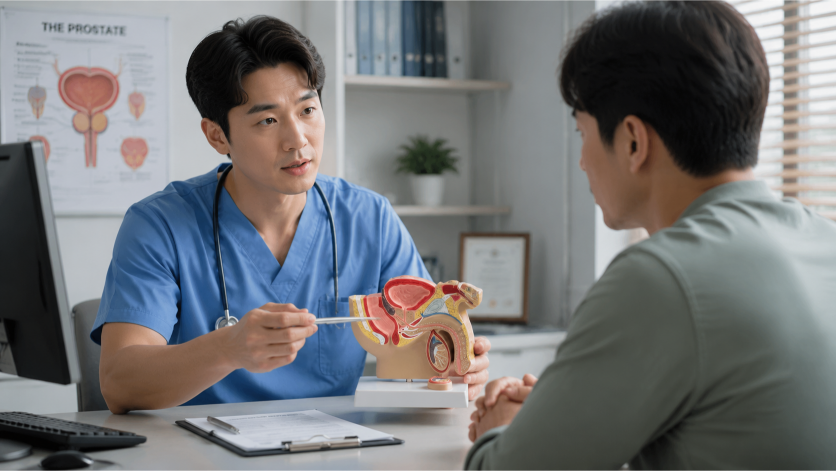
Prostate Surgery (Prostatectomy)
Also known as:
- Da Vinci Prostatectomy
- Minimally Invasive Prostatectomy
- Keyhole Prostate Surgery
- Laparoscopic Prostatectomy
Recovery
- Initial Phase: A catheter is typically used for 1–2 weeks
- Activity: Return to desk work in 2–4 weeks; resume physical exercise in 4–6 weeks
Considering Prostate Surgery (Prostatectomy)?
Compare transparent pricing from vetted specialists in minutes.
About Prostate Surgery (Prostatectomy)
PROSTATECTOMY: Control • Relief • Recovery
Precision Surgical Care | Eliminating Cancer & Restoring Urinary Healthy
A prostatectomy is a specialized surgical procedure to remove part or all of the prostate gland. It is primarily used as a definitive treatment for localized prostate cancer or to provide long-term relief from severe urinary symptoms caused by an enlarged prostate (BPH). Depending on your specific health needs, our surgeons use advanced techniques to remove obstructive tissue or the entire gland to ensure the best possible long-term outcomes.
Why It Is Done
✨ Treating Prostate Cancer (Radical Prostatectomy)
The entire prostate and seminal vesicles are removed to eliminate cancer cells and prevent them from spreading to other parts of the body.
Goal: Undetectable PSA levels and long-term cancer-free survival.
✨ Treating Enlarged Prostate (BPH)
For non-cancerous enlargement, blocking tissue is trimmed or removed to open the urinary channel.
Goal: Immediate relief from a weak stream, frequent urination, and the constant urge to go.
What You Will Achieve
✅ Effective Cancer Control: Complete removal of cancerous tissue with the goal of long-term survival.
✅ Restored Urinary Flow: Experience a significantly stronger urine stream and the feeling of a completely empty bladder.
✅ Improved Sleep: Drastically reduces the number of trips to the bathroom at night (nocturia).
✅ Enhanced Quality of Life: Freedom from the urgency and discomfort of urinary blockage.
✅ Nerve-Sparing Precision: Whenever possible, advanced techniques are used to protect the nerves responsible for bladder control and erections.
Ideal Candidate
Suitable for men seeking a definitive solution for prostate conditions.
You are the perfect candidate if you:
- Have early-stage or localized prostate cancer and want a surgical cure.
- Have a PSA level of ≤ 20 ng/mL with a medium–low risk cancer grade.
- Experience severe BPH symptoms that have not responded to medication.
- Seek a fast recovery and are focused on maintaining long-term functional control.
- Have an expected life expectancy of 10 years or more and are medically fit for surgery.
How It Is Performed
- Multi-parametric MRI and biopsy review
- General anaesthesia and Trendelenburg positioning
- 5–6 laparoscopic port placement
- Da Vinci Xi system docked at surgeon console with 3D vision
- Careful bladder and seminal vesicle dissection with nerve-sparing where oncologically safe
- Complete prostate and seminal vesicle excision
- Pelvic lymphadenectomy if indicated
- Precise vesicourethral anastomosis
- Catheter and drain placement
- Port closure
Hospitals Offering This
HospitalDoctors Performing This

Your Timeline
Preparation
- Multi-parametric MRI prostate within 3 months of surgery
- Prostate biopsy report with Gleason grade; bowel preparation day before
- Fasting 6–8 hours pre-operatively
- Smoking cessation at least 4 weeks
- Pre-operative Kegel exercises beginning 4–6 weeks before surgery
Followup Care
- Urinary catheter removed at 1–2 weeks
- First PSA at 6 weeks (target undetectable <0.1 ng/mL)
- PSA monitoring every 3 months year 1, every 6 months years 2–3, then annually
- Pelvic floor rehabilitation with supervised physiotherapy
- Sexual rehabilitation programme (PDE5 inhibitors, vacuum erection device) if nerve-sparing performed
Frequently Asked Questions
Is robotic prostatectomy better than open surgery?
Robotic prostatectomy provides equivalent or superior oncological outcomes with significantly less blood loss, less pain, shorter hospital stay (2–4 days vs 5–7 days), and faster return to normal activities.
Will I be incontinent after the operation?
Virtually all men experience some leakage immediately after catheter removal; the vast majority recover full continence within 3–12 months; pre-operative Kegel exercises significantly accelerate recovery.
What is nerve-sparing?
Preservation of neurovascular bundles alongside the prostate that control erectile function; whether nerve-sparing is safe depends on cancer location as assessed by MRI and biopsy results.
Will I need additional treatment after surgery?
If pathology shows clear margins, confined disease, and no lymph node involvement, PSA surveillance alone is appropriate; adverse pathology may prompt adjuvant or salvage radiotherapy.
· Next Step
Interested in Prostate Surgery (Prostatectomy)?
Connect with accredited specialists and get a personalised plan.