Thread Lift vs HIFU: Threads Hold Tissue, Ultrasound Heats It
Key takeaways
- They are not a stronger and a weaker version of the same treatment. A thread lift places an absorbable thread under the skin and holds tissue in a new position. HIFU, meaning high intensity focused ultrasound, heats tissue at a set depth and your own body builds the new collagen. Those are different physical actions.
- Laxity and descent are not the same problem, and the difference decides this. Lie back, look in a hand mirror, then sit up and look again. Whatever changes between those two views is descent. Whatever looks the same in both is skin that has lost its elasticity, and that is what energy treatments act on.
- "Ultherapy vs HIFU" compares one named machine to an entire category. Ultherapy is a brand of focused ultrasound device, and HIFU is the category it belongs to. The brand still matters, but as the axis of traceability rather than of result: a named machine has a manufacturer, a regulatory record and a supply chain, and the cartridge that delivers the energy is a consumable.
- Compare the quantity, not the headline price. Energy treatments are counted in lines or shots, and two clinics can both call something a full face while delivering very different amounts of energy. Ask each clinic how many lines or shots the price includes, and at what depths, before comparing anything.
- Case volume is a property of a clinic, not of a border. Where most patients have deeper skin tones, more cautious energy settings are the everyday default rather than something a doctor has to remember. That is a fact about what is routine in a particular room, and never a statement that doctors in one country are better than doctors in another. Ask any clinic, anywhere, how often they treat skin like yours on the machine they are proposing.
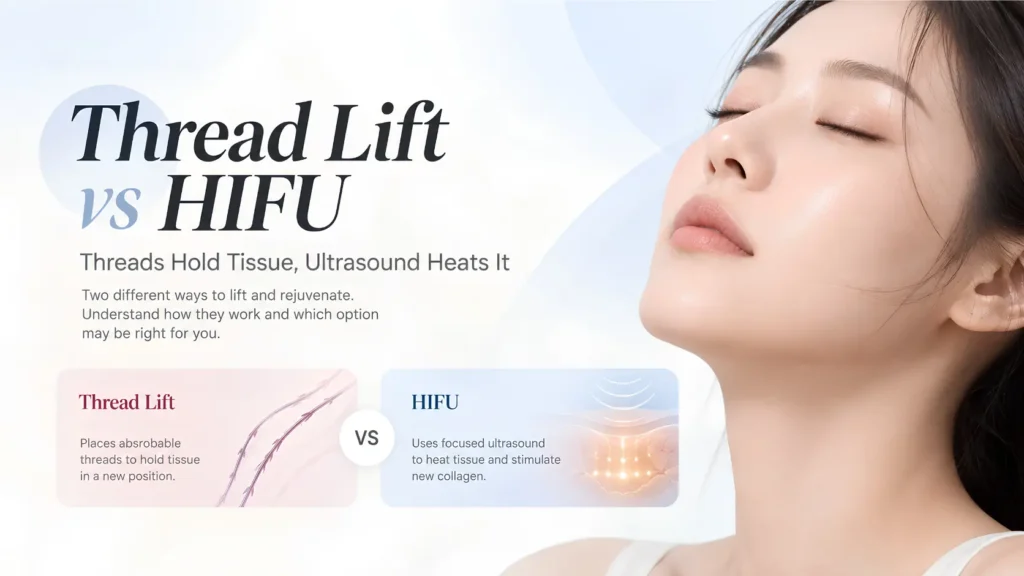
A thread lift places absorbable threads under the skin, which means threads the body slowly absorbs, and holds tissue in the position the doctor puts it in. HIFU, which stands for high intensity focused ultrasound, heats tissue at a set depth so that your own body makes new collagen over the months that follow. These are different physical actions rather than a stronger and a weaker version of the same treatment.
There is one point to make before the rest. Almost everything written about this comparison is published by a clinic that owns one of these machines. We do not own any of them. You pay the hospital directly, so whichever one you choose, it makes no difference to us.
Which one is right for you depends on what has actually changed. Skin that has lost its elasticity is a different problem from tissue that has begun to sit lower on the face, and the two problems do not respond to the same thing.
What Each One Physically Does
A thread lift is mechanical. A doctor passes a thin needle or a blunt tube under the skin and places a thread along the path. The thread has small barbs along its length, which are tiny hooks that grip the tissue. The doctor then pulls the tissue along the thread into a new position, and the thread holds it there.
The thread material is absorbable. The body absorbs it over time, so the mechanical hold fades as the material disappears.
HIFU is thermal. High intensity focused ultrasound sends sound waves through the skin and focuses them at a chosen depth below it, in the same way a magnifying glass focuses light at one point. The tissue at that point heats up. Heating tissue in a controlled way makes the body produce new collagen, which is the protein that gives skin its structure, and your body builds that collagen over the weeks and months afterwards.
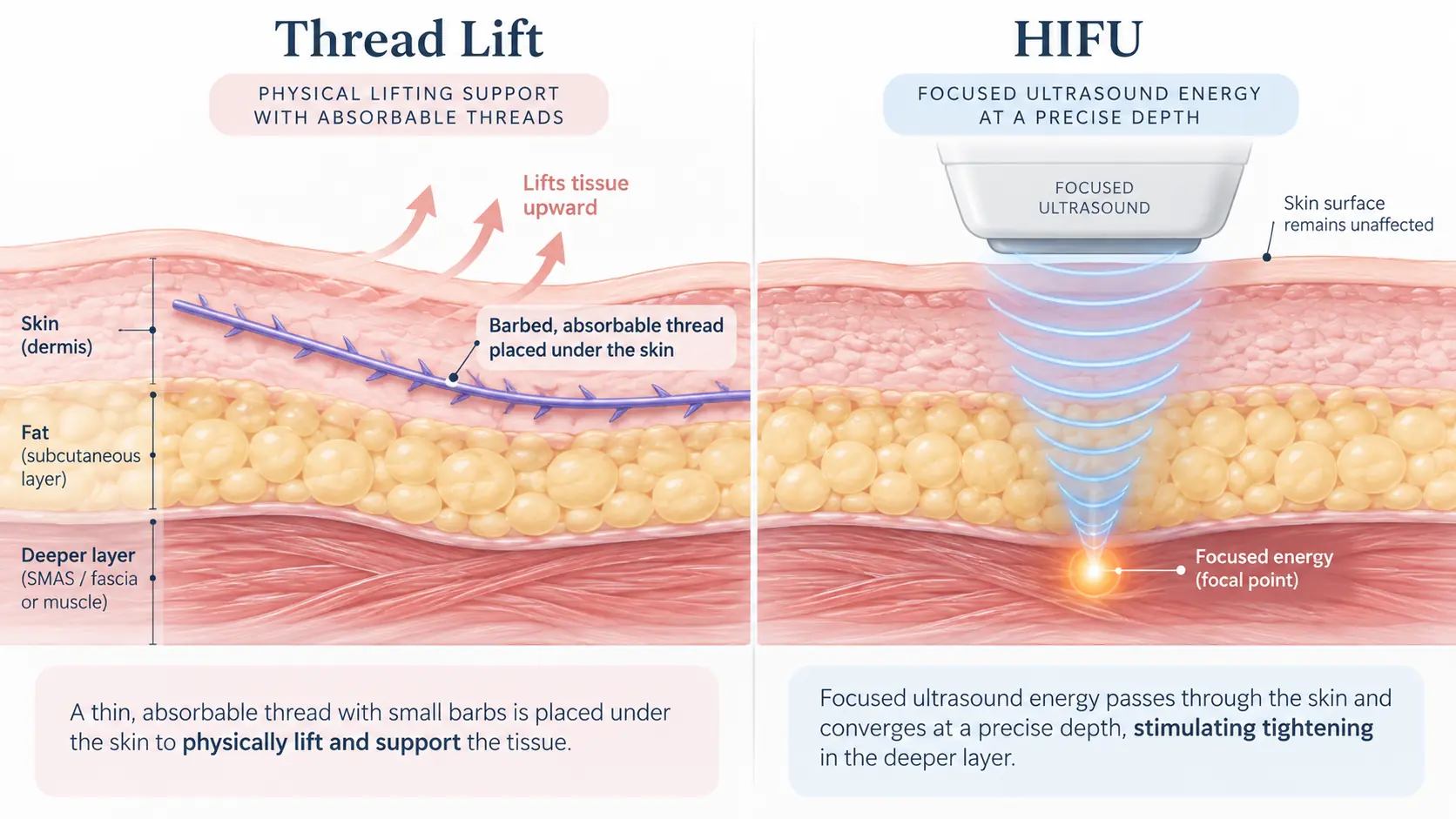
So the difference is not only a difference in strength. One treatment puts an object into your face and uses it to hold tissue. The other puts energy into your face, and your body does the building.
That explains a pattern people find confusing. After a thread appointment, someone can look different immediately. After an energy appointment, someone can look the same. Neither of those tells you which treatment was the right choice.
Which One Acts on What You Have
Two words get used loosely on clinic menus, and the difference between them decides this.
Laxity is skin that has lost its elasticity, meaning its ability to spring back, but has not yet carried the tissue underneath it downward. Descent is when that tissue has moved down. There is a quick way to see which one you have: lie back, look in a hand mirror, then sit up and look again. Whatever changes between those two views is descent. Whatever looks the same in both views is laxity.
One note on wording, because this article uses two terms for the same family of treatment. From here on, “energy treatments” means both focused ultrasound, which is HIFU, and radiofrequency. Both deliver energy from outside the body. Threads are the mechanical alternative to both.
Energy treatments act on laxity. They work with the tissue where it is now and try to improve its quality and its tone. Threads act on position, in a limited way, because they physically move tissue and then hold it. This is why a clinic will often suggest threads for an early jowl, which is a pocket of tissue that has begun to sit below the jawline. For skin that has become loose all over, without any one area dropping, a clinic will more often suggest an energy treatment.
Neither of them improves the quality of the skin surface itself. Dullness, uneven tone and fine surface lines are a separate group of problems with a separate group of treatments, and our comparison of Juvelook and Rejuran covers that group. A clinic that offers one of these lifting treatments as an answer to a surface problem is answering a question you did not ask.
An article cannot tell you whether your own change is laxity or descent. What an article can tell you is that the two are different, and that a treatment aimed at the wrong one will do very little, however many sessions you buy.
Most people cannot tell which of the two they have.
It is difficult to judge your own face. Send us a few photographs, including one taken from the side. A doctor at one of our partner hospitals will look at them and write back, usually within a few days. It is a starting point rather than a diagnosis, because nobody can diagnose from a photograph. We will not send you a plan or a price estimate unless you ask for one.
Message us with your photosIs a Thread Lift Dangerous?
This gets searched a lot, and it deserves an honest answer about what the procedure involves rather than a reassurance.
Start with what makes it different. An energy treatment stays outside your body. A thread lift breaks the skin, passes an instrument along a layer underneath it, and leaves a material inside.
That is a different category of procedure. It carries the kinds of problem that placing something under the skin can carry. The known ones are the thread becoming visible or possible to feel under the skin, the skin gathering unevenly where the thread was pulled, an uneven result between the two sides of the face, and infection. These are recognised categories of problem.
Nobody can tell you honestly how often any of them happens, and it is worth saying why. The published sources disagree with each other widely. Most of what is available online is written by clinics that perform the procedure. A single figure quoted across all thread types, all techniques and all operators would be invented, so this article does not give one.
What you can do instead is ask questions that have real answers. Which thread material is being used, and how long does the manufacturer say it takes to be absorbed. How many threads are being placed, and at which layer under the skin. What happens, and at whose cost, if one side settles differently from the other. What is the plan if a thread becomes visible. A clinic that answers all four without hesitating has done this many times.
There is one more thing worth knowing. Threads are absorbed, so a poor result is not usually a lasting one. But waiting for an absorbable material to disappear can take a long time, and that period is genuinely unpleasant. That is a reason to choose carefully at the start rather than a reason to relax about the choice.
Is Ultherapy the Same as HIFU?
This question comes up constantly, and almost every page answering it answers the wrong question.
Ultherapy is the brand name of one specific machine. HIFU, again, means high intensity focused ultrasound, and it is the category of technology that machine belongs to. Ultherapy uses a form of focused ultrasound and adds a real time imaging screen, so the person treating you can see the layers under the skin while they work. That imaging is a genuine difference, and it is worth being concrete about what it buys. The operator can see where the target layer actually sits on your face, rather than working from an average, and can see where structures lie that energy should not be placed near.
But look at what the usual comparison is actually comparing. On one side there is a named machine. On the other side there is the word HIFU, which in that sentence means any unnamed machine that the other clinic owns. That is not a comparison between two technologies. It is a comparison between one product and an entire category, and the category contains machines that range widely in age, in power and in how precisely they place energy.
You can see the consequence on the pages that make this comparison. Several of them describe HIFU as an unguided treatment that carries risks that Ultherapy does not carry, without naming which machine they mean and without citing anything. Pages making this comparison are frequently published by clinics that describe themselves as Ultherapy centres. The claim might be true of one particular machine. But when it is stated against a whole category, nobody can check it.
There is a fair version of the point those clinics are making, and it deserves an honest answer. A named brand is traceable. It has a manufacturer, a regulatory record and a supply chain. The word HIFU on a price list carries none of that. The category does contain machines nobody would want energy from, and the cartridge that delivers the energy is a consumable, which means a genuine machine can be run with a part that did not come from the manufacturer.
So the answer is not to dismiss the brand question. It is to ask the traceable version of it: which machine, from which manufacturer, and are the cartridges bought through that manufacturer’s distributor. A clinic that treats those as ordinary questions is a clinic that expects them. We list partner clinics that offer both branded and unbranded machines, which is why we have no reason to prefer either answer here.
What Actually Changes the Result
Four things vary far more than the brand does, and none of them appears in the name of the treatment.
The depth being treated. Focused ultrasound machines can deliver energy at more than one depth, and the right depth depends on where your tissue has changed. Treating the wrong layer is not a small error. It puts energy into a layer where your problem is not located.
The settings. The person treating you chooses the energy level, and also how much energy is delivered in each pass, meaning each sweep of the handpiece across an area. The same machine at two clinics is not the same treatment.
How much is delivered. Energy treatments are counted in lines or shots. One line, sometimes called one shot, is a single pulse of energy placed at one point, and a full face treatment is made up of many hundreds of them. Two clinics can both call a treatment a full face and deliver very different amounts of energy. Ask each clinic how many lines or shots the price includes, and compare those numbers rather than the headline price.
The person. Placing energy accurately at a chosen depth is a skill. Knowing when to stop is also a skill.
Skin Type Belongs in This List
Here is the useful thing to do with this, before the explanation. Ask any clinic, anywhere, how often they treat skin like yours with the specific machine they are proposing.
Energy treatments carry a risk of a dark mark remaining on the skin after it has been irritated, which doctors call post-inflammatory hyperpigmentation. That risk rises with deeper skin tones, which are classified on a scale called Fitzpatrick types.
Skin types are distributed differently across Asia. East Asian populations sit largely in Fitzpatrick types III and IV. Populations across island Southeast Asia, including Indonesia, Malaysia and the Philippines, sit largely in types IV and V. So in a clinic where most patients are types IV and V, lower and more cautious settings for that skin are the everyday default, rather than something the doctor has to remember to adjust.
That is the whole claim, and it is worth saying what it is not. It is not a statement that doctors in one country are better than doctors in another, and it does not mean a clinic in a country where most people have lighter skin cannot treat your skin well. How many cases a clinic sees depends on the clinic, not on the country it is in. Case volume is a property of a clinic, not of a border.
The Four Questions to Ask Any Clinic, Anywhere
These are the questions this whole article is really about. They work in Seoul, in Bangkok, in Kuala Lumpur, and at home.
- Which machine, from which manufacturer, and are the cartridges bought through that manufacturer’s distributor?
- What depth is being treated, and why that depth for my face?
- How many lines or shots does the price include?
- How often does this clinic treat skin like mine, on this machine?
A clinic that treats all four as ordinary questions is a clinic that expects them. If you are comparing two quotes, compare the answers to these four rather than the prices, because a cheaper treatment is often a smaller treatment.
Shurink, Ultraformer, Oligio: The Names Nobody Explains
If you look at a price list in Seoul, or in Bangkok, or increasingly in Kuala Lumpur, you will see names that do not appear in English-language articles at all. This is the part that confuses people standing in a clinic, and knowing which group a name belongs to tells you most of what you need to know.
Reaching a layer with energy is not the same as repositioning it, so the last column says where a machine is aimed rather than what it achieves. Knowing the names helps you read a menu and ask a sensible question. The result comes from the depth chosen, the settings used and the person using the machine, not from the machine being in the room.
The ultrasound group reaches deeper and concentrates energy at a point. The radiofrequency group heats the skin layer broadly, instead of concentrating the energy at one point. Clinics often present them as competitors. They are closer to being different tools, and a doctor suggesting one over the other is making a judgement about which layer your change is in.
Two of these names matter for a different reason. Shurink and Oligio are marketed mainly inside Korea, so readers outside Korea often cannot get them at home at any price. That is a real reason some people travel, and it is a more honest reason than a price comparison.
Knowing these names helps you read a menu and ask a sensible question. That is close to the whole value of knowing them. The result comes from the depth chosen, the settings used, and the person using the machine, not from the machine being in the room.
Doing Both, and in What Order
People ask about the order often enough that it is worth explaining, and combining the two is normal rather than something a clinic invented in order to sell you more.
Energy first, then threads, is the more common sequence when both are planned. The reasoning is that an energy treatment works on tissue quality over the following months, so placing threads afterwards means placing them into tissue that has already responded.
Threads first, then energy, is the order that needs more care, and it is worth saying plainly why. Focused ultrasound and radiofrequency both deposit heat, and an absorbable thread is a material sitting in the field where that heat lands. Heat can speed up how quickly an absorbable material breaks apart, and the thread also changes how energy travels through that spot. Neither of those is a reason to never do it. Both are reasons the interval and the placement have to be deliberate.
So ask this rather than assuming the answer: which material was placed, how long ago, and does this clinic treat over threads or around them. If nobody can explain why the plan runs in that order, ask more questions.
Threads Fit One Trip. A Course Does Not.
The two treatments need different kinds of trip, and this is worth knowing before you plan anything, because we deal with the consequences directly.
A thread lift is a single appointment. There is swelling and bruising afterwards, and there are movement restrictions in the days that follow, which usually include not opening the mouth widely and not sleeping on your side. That fits into one trip, as long as the trip is long enough to include the follow-up visit, rather than ending the day after the procedure.
Energy treatments are more varied. Some are given as a single session with a review months later. Others are given as a course spread over weeks, and a course spread over weeks does not fit into one journey. If you are two or three hours away by air, you can return, and this works. If the flight is a long-haul flight, it usually does not work, and starting a course you cannot finish is worse than not starting one.
We will tell you when that is the case. If what you need is a course of energy treatments spread over several months, flying for it is usually a bad plan, and that is a case where we are not the right service. Before booking anything, ask the clinic whether what they are proposing is one session or a course, and how many visits the full plan involves.
The Short Version
Threads hold tissue mechanically, and they do it on the day of the treatment. HIFU, which is focused ultrasound, heats tissue at a depth, and your body responds over the following months. Neither is a stronger version of the other. The choice follows from whether your change is skin that has lost its elasticity or tissue that has begun to sit lower.
The rest is not a choice between brands. Take the four questions into any consultation: which machine and whose cartridges, what depth, how many lines or shots, and how often this clinic treats skin like yours. A clinic that answers those clearly is worth listening to. A clinic that answers by telling you which brand it owns has answered a different question.