
Loose Skin or Fat? How to Tell, and What Each One Needs

Key takeaways
- These are three different things, not one. Fat under the skin, skin that has lost its ability to pull back, and a separation of the muscle wall underneath all look similar from outside and need completely different things.
- Two minutes of checks narrows it a long way. Pinch and see whether what lifts is thick or thin, compare standing with lying down, and feel for a gap along the midline during a small head lift.
- Most people have more than one of the three. That is the normal case rather than the exception, and it is the usual reason one procedure delivers less than someone expected.
- Losing more weight makes loose skin more visible, not less. If the skin has already lost its recoil, taking away what fills it reveals the looseness that was being held taut from the inside.
- If the muscle wall underneath is slack, treating the layer above it does not change the shape. This is the most common reason a stomach is still not flat after fat has been treated.
If your stomach has not changed the way you expected, there are three different reasons it might not have, and they feel almost identical from the outside. One is fat. One is skin that has lost its ability to pull back. One is the muscle underneath having separated. They need completely different things, which is why telling them apart is worth doing before anything else.
This article is about telling them apart, which you can mostly do yourself in about two minutes. It does not compare treatments, and it will not tell you what you have. It will tell you which question to bring to a doctor, which is a much shorter conversation than arriving with a general dissatisfaction.
The Quick Check
Three checks. Do the first two in front of a mirror and the third one lying down.
Which ones apply to you. The first two work anywhere skin has been stretched, including the upper arms, the inner thighs and under the chin. The third applies to the abdomen only, because it is about a muscle wall that exists there and nowhere else. If you are here about your arms or your chin, do checks one and two and skip check three.
1. The pinch. Do this in more than one spot, because the answer often differs across one stomach. Try above the navel, below the navel, and at the side just above the hip bone. In each spot, take what is there between your thumb and fingers and lift.
If what you are holding is thick and soft and rolls between your fingers, there is fat in it. If what lifts is thin, folds like fabric and stays creased for a moment after you let go, that part is skin. Getting a different answer above and below the navel is common, and the difference is itself useful.
2. Standing, then lying down. Look at the area standing, then lie flat on your back and look again. Fat tends to flatten and spread outwards when you lie down. Loose skin tends to fall towards the floor and gather, and the shape changes far more than fat does.
3. The head lift. Do this one slowly. Most people have never felt their own abdominal wall, so there is nothing to compare against until you find the edges.
Lie on your back with your knees bent and your feet flat. Place two or three fingertips flat on the midline just above your navel, pointing down towards your feet, and press gently in. With your head still down, the area will feel soft and you may not feel much at all. That is normal, and it is not the measurement.
Now lift your head and shoulders slightly, as if you were starting to sit up, and keep pressing. As the muscles tighten, you should feel a firm edge arrive on each side of your fingers. Those edges are the thing you are looking for, and the measurement is how many finger widths sit between them. Repeat just below the navel, and once more a few centimetres higher up.
If the edges close in and grip your fingers, there is no meaningful gap in that spot. If they stay apart and two or more fingers fit between them, that points to a separation of the muscle rather than to anything in the skin or fat above it. If you cannot find the edges at all, there is usually enough fat above them to hide the check, which is its own answer.
Reading the results. Most people get more than one of the three, and that is the normal outcome rather than a failed test. What to do with a mixed answer is to work out which one is largest, because that is what decides where a plan starts.
- Mostly thick in the pinch, little creasing, edges that grip your fingers. Fat is doing most of the work.
- Thin and creasing, and the shape changes a lot between standing and lying down. Skin is doing most of it. This is also the answer least likely to change with more time in the gym.
- Two or more fingers between the edges. The muscle is part of it whatever else you found, and it is usually looked at first, because what the other two need is decided differently once it is settled.
These checks narrow the question. They do not settle it. How much of each you have, and what that means for you, is something a doctor decides after looking, and no self-check replaces that.
Did the checks leave you unsure?
That is the normal outcome when more than one of the three is present, which is most people. Send a few photos and we will get a doctor’s initial read on which of them is doing the most work in your case. No plan and no quote unless you ask for one.
Message us with a photoWhy Fat and Loose Skin Feel the Same
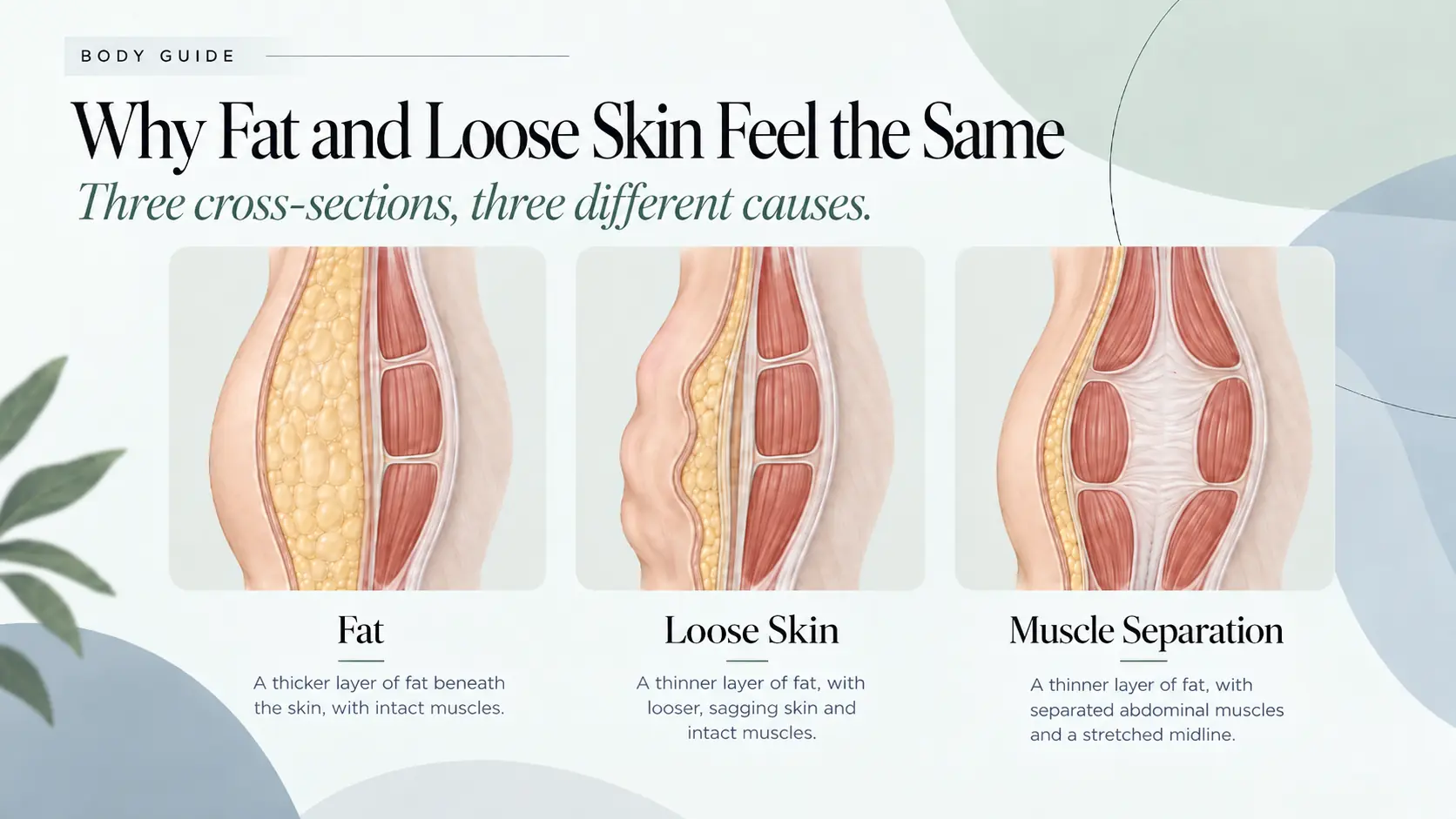
Fat sits in a layer underneath the skin. Skin is the envelope over the top of it. When there is a lot of fat underneath, the envelope is stretched tight over it, and the whole thing reads as one solid mass. That is why a stomach that is mostly fat often looks smooth and firm rather than loose.
Skin stretches to accommodate what is underneath, and its ability to draw back afterwards is not unlimited. Pregnancy and significant weight gain both stretch it over long periods. How much of that stretch is recoverable depends on how long it was stretched, how far, your age, and genetics, none of which you chose.
This is why losing more weight sometimes makes the appearance worse rather than better. Take fat out from underneath skin that has already lost its recoil and the envelope has less to fill it. The volume goes down and the looseness becomes more visible, not less. Nothing has gone wrong when this happens. It means the remaining issue was never the fat.
The Third Thing, Underneath Both
Your abdominal wall has two vertical columns of muscle running down the front, joined along the midline by a band of connective tissue. When that band is stretched for long enough, the two columns separate and the band stays wide. Doctors call this diastasis recti, or an increased inter-rectus distance.
A separation is not a hole and it is not a hernia. The wall is still closed, but it is slack in the middle, so pressure from inside pushes forward through the slack part. That is why some people describe a stomach that is flat in the morning and rounded by evening, or one that stays domed no matter how lean the rest of them gets.
For scale, a 2026 study of 525 women after childbirth classified a gap of less than 2 cm as normal, 2.0 to 2.9 cm as mild, 3.0 to 3.9 cm as moderate, and 4 cm or more as severe. The same study identified caesarean delivery, having had more than one pregnancy, higher birth weight and higher weight gain during pregnancy as independent risk factors for the severe band. Those are population level findings and not a measurement of you.
This is also the most common reason someone is still not flat after having fat treated. It is worth re-reading the head lift check if you skipped it. If the wall underneath is slack, taking away the layer above it does not change the shape it is holding.
What Each One Actually Needs
One line each, because choosing between the options is a separate conversation and a separate article.
Most people have more than one of these at once, in different proportions.
Two things follow from that table, and they are the reason it is worth doing the checks before booking anything.
Mixed pictures are the normal case, not the exception. Someone with fat and loose skin who treats only the fat gets a smaller version of the same problem. Someone with a muscle separation who treats only what is above it stays domed.
The order sometimes matters. Where a separation is present and recent, the usual advice is to work on it before deciding about anything surgical, because the picture can change. A doctor who asks how long ago you gave birth before answering your question is doing this correctly.
What Does Not Change Any of This
These come up constantly, and most of them do something real. They just do not act on the thing you are asking about.
Firming creams and lotions. These work at the surface of the skin. Loss of recoil is a change in the deeper structure of the skin, several layers below where anything applied on top reaches.
More weight loss, when the issue is skin. Covered above. If the envelope has lost its recoil, taking away what fills it makes the looseness more visible.
Crunches and sit-ups, when there is a separation. Core work genuinely helps a separation, but not all of it. Movements that push the abdominal wall outwards under load can widen the gap rather than close it, which is one of the few situations where seeing a physiotherapist before you try anything on your own is worth the appointment.
Waist trainers and shapewear. These compress while worn. Compression changes the outline for the evening and does not change fat, skin or the muscle underneath.
The Same Question, Other Places on the Body
The same three-way question applies wherever skin has been stretched, and people ask it most often about the upper arms, the inner thighs, and under the chin.
The pinch test transfers directly to all three. The lying-down comparison works for arms and thighs but not for the chin, where turning your head from side to side and watching what moves is the closer equivalent. The muscle check does not apply anywhere except the abdominal wall.
What changes between areas is not the question but the answer. The skin on the upper arm is thinner and its recoil is lost sooner, so the arms often reach the loose-skin category earlier than the stomach does in the same person.
Frequently asked questions
I lost a lot of weight and my stomach looks worse than before. What happened?
Will loose skin tighten on its own if I wait?
How long after giving birth should I wait before deciding anything?
I had liposuction and my stomach still is not flat. Why?
Is there a non-surgical option for loose skin?
Does the same thing happen under the chin?
More from the Journal
All articlesMedical disclaimer: This content is for informational purposes only and is not a substitute for professional medical advice, diagnosis, or treatment. Read our full Medical Disclaimer.