Liposuction or Tummy Tuck: Which One, and In What Order
Key takeaways
- Liposuction takes fat away, and only surgery takes skin away. The muscle wall underneath is a separate problem again, and which of these is producing the shape decides which treatment does anything at all.
- Cooling devices reduce fat, and heating devices act on the skin rather than the outline. No external device shortens skin that has been stretched a long way, and only surgery takes skin away.
- Doing both at once has a name, and the evidence on it is reassuring rather than conclusive. A 2019 meta-analysis of 17 trials and 14,061 patients found fewer complications for lipoabdominoplasty than for a tummy tuck alone, from observational studies where surgeons chose which patients had which operation.
- Timing rules a lot of people out for now. Not having finished having children, a weight that is still moving, smoking and a recent birth are the usual reasons a surgeon says wait, and a consultation that skips them has skipped the part that matters.
- A tummy tuck usually includes the muscle repair, and a quote does not always say so. Ask which of the three actions a quoted operation covers, by name, because muscle repair and liposuction done at the same time are frequently part of the surgery and not always part of the price.
By the time most people search this question, they have already been given an answer. Often more than one, and the answers do not agree. A consultation said one thing, a forum said another, and a search result said a third.
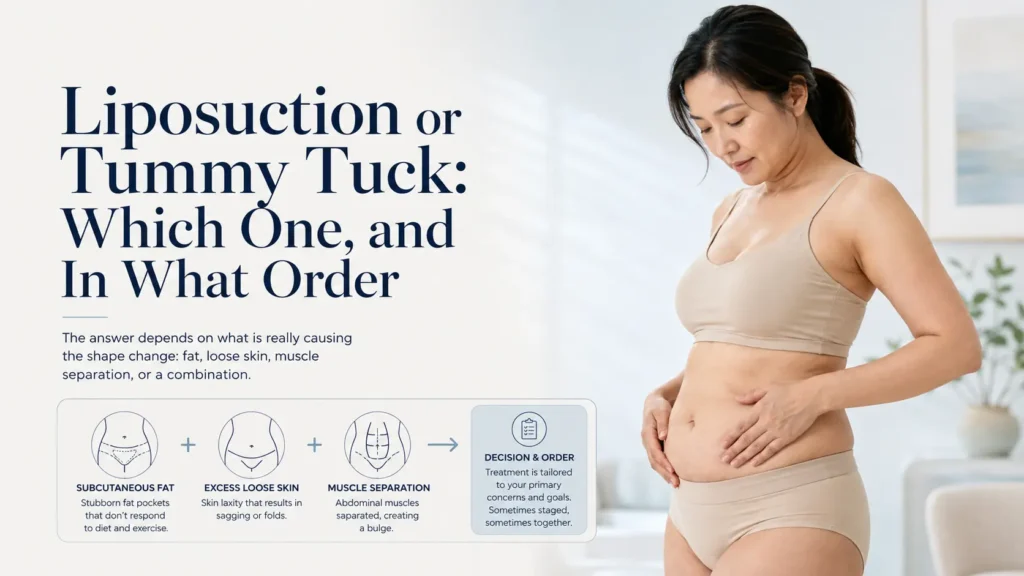
They disagree because the answer depends on something that has not been settled yet. Three different things can produce a stomach that does not look the way you expect, and which of them you have decides which treatment does anything at all. This article does not work out which ones you have. That question comes first and it has its own checks.
Why This Is Not Always a Two Way Choice
The question is almost always asked as a choice between two operations. That framing is correct only if you have exactly one of the three problems, and it is not correct if you have more than one.
The three are fat under the skin, skin that has lost its ability to draw back, and a separation in the muscle wall underneath both. They can occur on their own. They can also occur together, and when they do, treating one leaves the other two untreated.
So the useful question is not always which operation. Sometimes it is which combination, and in what order. What each option physically does is below, and whether this is the right time at all is a separate question further down.
What Each Group Physically Does
Grouped by what each treatment does to tissue, rather than as a list of procedure names. The grouping is the part that transfers to any clinic menu you are handed, because different clinics use different names for the same physical action.
The last row is the one that catches people out most often, so it is worth stating plainly. A separation is a gap in the connective band between the muscles. Making the muscles themselves larger does not close that gap.
Where the Non Surgical Options Actually Land
Non surgical treatments do real work, and for one group of people they are the right answer and this article can stop there.
The published effect for cryolipolysis, which is the cold based fat treatment sold as CoolSculpting and under several other brand names, is measurable. A 2025 systematic review and meta-analysis of 30 studies and 3,158 participants reported an average reduction in waist circumference of 3.56 cm at 12 weeks compared with the starting measurement, and an average reduction of 5.22 mm in the thickness of fat just above the hip bone (Obesity Reviews, 2025). The range around that fat thickness figure is wide, so the pooled estimate is less precise than the single number suggests.
So there is a reader for whom this is the answer, and the description is fairly specific: a distinct pocket of fat rather than a general layer, skin that has kept its recoil, no separation in the wall underneath, and no realistic way to take several weeks away from work. That combination is the case where non surgical treatment is doing the job it is good at, and surgery would be the larger intervention.
Two things about cryolipolysis are worth knowing and are usually missing from a clinic’s own page. The same 2025 review reported minor side effects at high rates: numbness in 49.5% of patients, redness in 44.5%, swelling in 30.5% and pain in 28.8%. Those effects are described as mild and temporary, and the reported satisfaction rate in the same review was 80.4%, so this is not an argument against the treatment. It is an argument for knowing in advance what the following weeks are usually like.
The second is rarer and matters more. There is a reaction called paradoxical adipose hyperplasia, in which the treated area grows instead of shrinking. A 2025 systematic review and meta-analysis of 28 studies and 13,078 patients estimated the pooled rate at 0.22%, which is roughly 1 patient in 455, and the authors state that this appears to be higher than manufacturer reports (Aesthetic Surgery Journal Open Forum, 2025). They also rate the evidence as low certainty and note that only four of the studies followed patients for 16 weeks or longer.
Radiofrequency devices are sold for the other half of the non surgical offer, which is tightening skin rather than reducing fat. The evidence supports the skin part more clearly than the shape part. A 2025 open label study of 17 women with abdominal skin looseness after pregnancy found significant improvement in skin elasticity and in ultrasound measures of the skin itself, while the reduction in waist circumference did not reach statistical significance (Journal of Dermatological Treatment, 2025). That study had 17 participants and no comparison group, so it is a small piece of evidence rather than a settled answer.
The honest summary for energy based tightening is therefore narrow, and it is narrow in what is known as much as in what is claimed. Measured improvement in the skin itself was reported in that study. Whether the outline of the abdomen changes was not established by it, and that is a different statement from a finding that it does not.
One gap in this evidence is worth naming, because it affects a lot of the people reading this. Most trials of cryolipolysis were run in populations with lighter skin, and the specific worry for darker skin has been a higher risk of pigment changes. A 2019 review found only four trials run entirely in Asian populations, two in Korea, one in China and one in Thailand, and reported no pigment changes and results similar to the lighter skinned data (Open Access Macedonian Journal of Medical Sciences, 2019). Four trials is a small evidence base and not a settled answer. It also does not mean that any country is a better or worse place to have this done. A busy clinic anywhere can have far more experience with a given skin type than a quiet clinic in a country whose population happens to skew that way.
What Does Not Act on What You Have
Most treatments in this field do something real. The problem is when the thing they do is not the thing you need. That runs in both directions. A treatment can be too small for the problem, and a treatment can also be larger than the problem requires.
Cryolipolysis, when the main issue is skin. Cooling fat reduces the layer underneath an envelope that has already lost its ability to draw back. The volume goes down and the looseness becomes easier to see, not harder.
A tummy tuck, when the skin still has good recoil. If the skin springs back and the change you dislike is a layer of fat, an operation that takes skin away and leaves a scar across the lower abdomen is aimed at something you do not have much of.
Muscle stimulation devices, when there is a separation. Covered in the table above. These devices make muscle larger. A separation is a gap in the band between the muscles, and a larger muscle does not close it.
Contouring surgery, when the fat is behind the muscle wall rather than under the skin. Fat inside the abdomen, around the organs, pushes the wall forward from the inside. This is a fourth thing, and it sits outside the three above because it is behind the wall rather than in front of it. No contouring procedure acts on it, because none of them go behind the muscle wall. A doctor who presses on your abdomen before answering your question is checking for this.
Skin tightening devices, on skin that has been stretched a long way. These act on mild looseness. The limit is structural rather than a question of doing more sessions, because heating skin does not take any of it away.
A full tummy tuck, where a smaller one would have done. The smaller version treats skin below the navel only, with a shorter scar and a shorter recovery. If the looseness sits below the navel, the larger operation buys a longer scar and a longer recovery for nothing.
Liposuction on its own, when the wall underneath is slack. The wall holds a shape. Reducing the layer above a slack wall does not change the shape the wall is holding, which is why some people are still not flat after fat has been treated.
Muscle repair, when the wall is intact. Repair is worth doing when there is a separation to close. Where the two muscle columns already meet, stitching the band adds operating time and recovery to an operation that did not need it.
When the Answer Is Not Yet, or Not You
This is a different question from the one above. Above is about the right tool for the problem. This is about the right time, and about whether an operation is a reasonable idea for you at all.
If you have not finished having children. A pregnancy stretches the abdominal wall and the skin again, and it can undo a muscle repair. This is one of the common reasons a surgeon suggests waiting.
If your weight is still moving. Both operations act on the body you have on the day. Losing a significant amount afterwards leaves skin that was not accounted for, and gaining it back changes the result in the other direction. Surgeons commonly ask for a stable weight over some months before agreeing to operate.
If you smoke. Nicotine narrows small blood vessels, and an abdominoplasty depends on blood supply to a flap of skin and fat that has been lifted off the wall. This is why clinics ask about smoking, and why the answer changes what they are willing to do.
If you gave birth recently. The wall and the skin keep changing for months afterwards, and a measurement taken early does not describe where things settle. A surgeon who asks how long ago you gave birth before answering your question is doing this correctly.
If a clinic does not ask about any of the above. Every item here is standard, and none of it is controversial. A consultation that moves to booking without covering them has skipped the part that decides whether the operation is a good idea.
Not sure which side of that list you are on?
Whether this is the right time is easier to answer on one real case than in general. Send a few photos and anything a clinic has already quoted you, and we will get a doctor’s initial read on it. Some of what decides this is checked by hand rather than from a photograph, so a first read tells you which questions to take to that appointment.
Message us with a photoThe Operation That Is Both
Doing two of these in one operation has a name. Clinics list it as lipoabdominoplasty, which means liposuction and a tummy tuck performed in the same procedure, usually with the muscle repair included.
This combination was argued about for a long time, and the reason was specific rather than general. An abdominoplasty lifts a flap of skin and fat off the abdominal wall, and that flap depends on a blood supply that liposuction in the same area could damage. The concern was that combining the two would raise complication rates.
One published check on that question is a 2019 systematic review and meta-analysis of 17 trials and 14,061 patients (Aesthetic Plastic Surgery, 2019). It found fewer complications in the combined group than in the group who had a tummy tuck without liposuction, including lower rates of two specific problems: blood collecting under the skin (haematoma) and fluid collecting under the skin (seroma). Across all 14,061 patients in both groups, fluid collection was reported in 4.1%, blood collection in 0.8%, wound infection or wound separation or fat necrosis in 5.6%, deep vein clots in 0.2% and scar problems in 0.7%.
Two things about that result matter as much as the result itself. Its own conclusion is worded as no evidence of higher complication rates, and that is a different statement from evidence of no difference between the two. The journal also rates it Level III evidence, which means the underlying studies observed what surgeons had already chosen to do rather than assigning patients at random.
That second point has a specific consequence. Surgeons choose the combined operation for the patients they judge to be in the best condition for it. That selection on its own could produce this result without the technique being responsible for any part of it. The finding is genuinely reassuring about the combination as it is currently practised, and it is not the same as a finding that the combination is safer for any given person.
One Operation or Two Trips
Where the combined operation is not the plan, the work gets split, and the question becomes what is done first.
The usual reasoning is about the skin. An abdominoplasty is planned around how much skin there is to work with, so doing a large amount of fat reduction first changes the measurements the second operation is planned from. Where both are wanted and they are being separated, that is one reason the fat work may be planned to follow rather than lead. The order for your own case is a judgement made by the surgeon who will do it, and a clinic that can explain the sequence it is proposing is telling you something useful about how it plans.
Splitting has real costs and they are easy to underestimate. Two operations means two lots of anaesthesia, two recoveries and two periods away from work. For anyone travelling, it also means two trips rather than one, and the second trip has to wait until the first has settled.
It also has a real advantage, which is that nothing has to be decided at once. A shorter operation is a smaller undertaking, and a result that turns out to be enough on its own is a result you did not need a second operation for.
If You Are Planning This Around Travel
Both operations fit the shape of a single trip, which is not true of most treatments in aesthetic medicine. There is one appointment rather than a course spread over months, so distance does not rule this out the way it rules out repeated sessions.
What travel changes is the length of the stay rather than whether it is possible. Recovery from an abdominoplasty is measured in weeks, not days, and the early part of it is the part that has to happen somewhere. Flying after abdominal surgery has its own timing rules, and they exist for a physical reason to do with cabin pressure and blood clots rather than for a clinic’s convenience.
One thing worth checking before you agree to anything is what a quoted package actually contains. Muscle repair is frequently included in a full tummy tuck and it is not always included in a quoted price, and the same is true of liposuction performed at the same time. Ask which of the actions in the table above the quote covers, by name. A quote that lists the operation without listing what is being done inside it has not answered that question.
Frequently asked questions
How do I know whether I am ready for this yet?
How long do I need to stay if I travel for this?
Is liposuction or a tummy tuck safer?
Is one cheaper than the other?
Do I need the muscle repair, or can I skip it?
How bad is the scar?
Does any of this apply to men?
Which should I have first, the liposuction or the tummy tuck?
Mentioned in this guide
02 items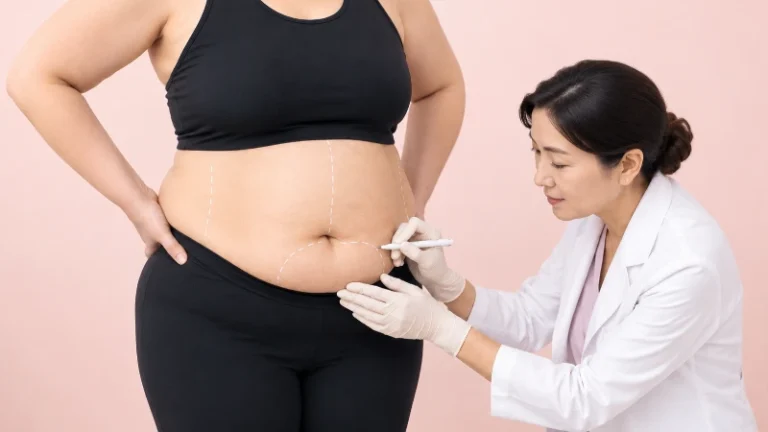 Procedure
Liposuction
Removes stubborn, diet-resistant fat. Sculpts & defines body contours. Permanent fat cell reduction. Improves proportions & shape. Tightens skin mildly. Targets abdomen, arms, thighs, chin. Slims & refines silhouette. Long-lasting results.
View procedure
Procedure
Liposuction
Removes stubborn, diet-resistant fat. Sculpts & defines body contours. Permanent fat cell reduction. Improves proportions & shape. Tightens skin mildly. Targets abdomen, arms, thighs, chin. Slims & refines silhouette. Long-lasting results.
View procedure
 Procedure
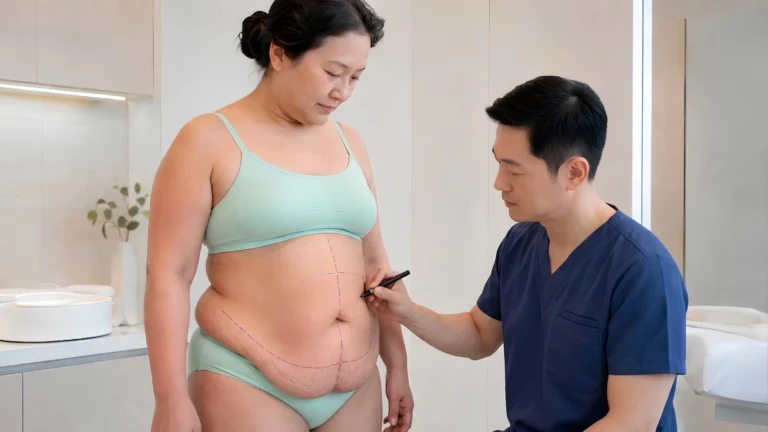
Tummy Tuck (Abdominoplasty)
Eliminates “apron” skin and stubborn belly fat. Tightens separated or weakened core muscles. Creates a flatter, firmer, and more toned stomach. Relieves back pain and improves daily posture. Removes lower abdominal stretch marks permanently. Restores body shape after weight loss or pregnancy. Sharpens the waistline and overall body profile. Dramatically improves how clothing fits and feels.
View procedure
Procedure
Tummy Tuck (Abdominoplasty)
Eliminates “apron” skin and stubborn belly fat. Tightens separated or weakened core muscles. Creates a flatter, firmer, and more toned stomach. Relieves back pain and improves daily posture. Removes lower abdominal stretch marks permanently. Restores body shape after weight loss or pregnancy. Sharpens the waistline and overall body profile. Dramatically improves how clothing fits and feels.
View procedure
More from the Journal
All articlesMedical disclaimer: This content is for informational purposes only and is not a substitute for professional medical advice, diagnosis, or treatment. Read our full Medical Disclaimer.