
Can You Get Rid of Fat Without Surgery? The Best Non-Surgical Options Explained
You eat well.
You exercise.
Your weight is relatively stable.
But somehow, that one pocket of fat is still there.
Maybe it’s your lower abdomen. Maybe it’s your love handles, thighs, arms, or double chin.
So you start looking into liposuction and then immediately wonder:
“Do I really need surgery to get rid of it?”
Not necessarily.
There are now several non-surgical body contouring treatments designed to target unwanted fat without incisions or a surgical procedure.
But there’s an important detail that often gets lost in the excitement:
Non-surgical does not mean the same thing as liposuction.
The technologies work differently, the results develop differently, and the amount of change can be different too.
So before you decide what sounds appealing, here’s what you need to know.
First: What Does “Non-Surgical Body Contouring” Actually Mean?
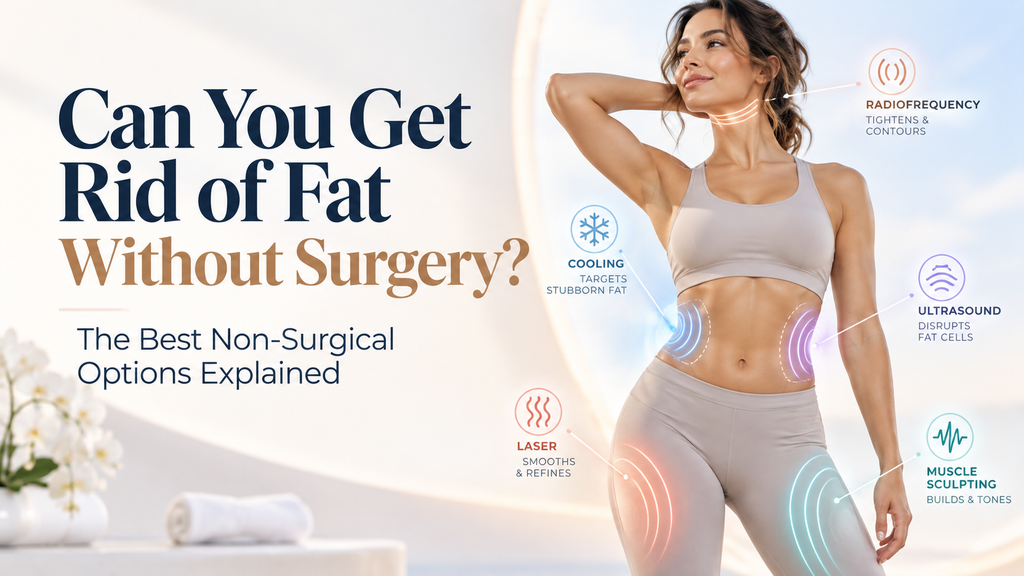
Non-surgical body contouring refers to treatments that use energy or other techniques to target localized areas of fat without surgically removing the fat.
Depending on the technology, treatment may use:
- Cooling
- Radiofrequency energy
- Ultrasound
- Laser energy
- Electromagnetic muscle stimulation
- A combination of technologies
The goal is generally body contouring, not weight loss.
In other words, these treatments are designed around specific areas and body shape rather than replacing diet or exercise.
The Non-Surgical Body Contouring Menu
There isn’t just one type of non-surgical fat reduction.
Different technologies approach the problem differently.
The machine name matters less than understanding what the technology is designed to do.
And that leads to a more useful question:
Why Do People Choose Non-Surgical Treatment Instead of Liposuction?
For some people, the appeal is simple:
They want to work on stubborn fat without having surgery.
That can mean avoiding:
- Surgical incisions
- An operation
- Anaesthesia
- A longer recovery period
- Planning life around postoperative downtime
There is also the psychological side.
For someone with a relatively small area of concern, the idea of having a non-surgical treatment can simply feel less intimidating than undergoing an operation.
Others like the idea of making gradual changes rather than pursuing a major transformation all at once.
And for some people, “I don’t want surgery” is the starting point of the search.
So, Which Body Areas Can Be Treated?
Non-surgical body contouring is commonly used for localized areas where people notice stubborn fat or want more definition.
Depending on the technology, treatment areas may include:
- Abdomen
- Love handles
- Thighs
- Arms
- Back
- Under the chin
- Other localized areas
But there isn’t one machine that treats every area in exactly the same way.
The applicator, technology, treatment depth, and treatment plan can all differ.
That’s why seeing a machine advertised for “fat reduction” doesn’t automatically mean it is designed for every part of the body.
What Actually Happens to the Fat?
This is where non-surgical treatments become particularly interesting.
With liposuction, fat is physically removed from the body during a surgical procedure.
With non-surgical technologies, the process depends on the treatment.
For example:
Fat freezing uses controlled cooling to target fat cells.
RF treatments use heat energy and may combine fat reduction with skin-tightening effects.
Ultrasound uses focused sound energy to target fat.
Laser-based treatments use laser energy to affect targeted fat cells.
Muscle-stimulation technologies focus on powerful muscle contractions while also addressing fat.
So although several treatments may be marketed under the same umbrella of “body contouring,” they aren’t doing exactly the same thing.
The Part People Often Don’t Realize: Results Are Gradual
This is one of the biggest differences between non-surgical treatment and liposuction.
Non-surgical body contouring generally isn’t a:
“Walk in with fat → walk out without it” experience.
The body needs time to respond to the treatment and process the targeted cells.
Depending on the technology, improvements may develop gradually over the following weeks or months.
Some treatments may also involve more than one session.
That makes non-surgical contouring particularly different from the way people often imagine liposuction.
Non-Surgical vs Liposuction: What’s Actually Different?
Rather than asking which one is “better,” it is more useful to understand how they differ.
Neither column tells you what you should choose.
It simply shows why the experience can be very different.
What Are the Biggest Advantages of Going Non-Surgical?
The appeal isn’t difficult to understand.
Less disruption to everyday life
Many non-surgical treatments involve little or no downtime compared with surgery.
No surgical incisions
There is no surgical removal of fat.
Gradual changes
Some people prefer results that develop progressively rather than undergoing a major body transformation at once.
More options
There are now different technologies targeting fat, skin firmness, muscle definition, or combinations of these concerns.
A different starting point
For someone exploring body contouring for the first time, non-surgical treatment can be another option to discuss with a specialist.
But Non-Surgical Doesn’t Mean “No Limitations”
This is the part worth paying attention to.
Non-surgical body contouring isn’t simply liposuction without the surgery.
Results can be:
- More gradual
- More subtle
- Dependent on the technology used
- Dependent on the treatment area
- Different from one person to another
Some treatments may also require multiple sessions.
And if someone is expecting a dramatic change in body shape, simply choosing a treatment because it is non-surgical may not automatically mean it will deliver the result they imagined.
The word “non-surgical” describes the procedure — not the size of the result.
What About Skin Tightening?
Here’s another reason body contouring can get confusing.
Fat reduction and skin tightening are not necessarily the same thing.
Some technologies are designed primarily around fat reduction.
Others may also target skin firmness.
And some treatments focus more heavily on muscle definition.
So if your concern is actually:
“I have less fat, but my skin feels loose.”
that’s a different conversation from simply asking how to reduce a pocket of fat.
Are the Results Permanent?
Another common question is whether the treated fat will simply come back.
The answer depends on the technology and individual circumstances.
Some non-surgical treatments target fat cells that are subsequently processed by the body. However, this does not mean future weight changes are impossible.
The body can still change over time.
That is why body contouring should be thought of as contouring, rather than a permanent guarantee against future fat gain.
So… Can You Get Rid of Fat Without Surgery?
Yes, but “without surgery” comes with its own set of expectations.
Non-surgical body contouring has opened up more choices for people who want to address localized fat without undergoing an operation.
But it isn’t simply a less intense version of liposuction.
The technologies work differently.
The experience is different.
The timeline is different.
And the type of result can be different.
That’s why the more useful question isn’t:
“Which treatment is the best?”
It’s:
“What does each option actually do, and how does that compare with the change I’m hoping to achieve?”
Once you understand that difference, a conversation with a qualified specialist becomes much more useful.
And if you’re considering treatment abroad, the same principle applies: understand the available options, what each treatment involves, and the estimated approach before deciding what fits your goals.