 Hospital
You You We, Go Go Go!
LASIK
Also known as:
- Refractive Eye Surgery
- Vision Correction
Recovery
- Most clients experience a “wow” moment of clearer vision within the first 24 hours
- Mild dryness or light sensitivity is normal on Day 1
- You can typically return to most daily activities and work within one week
Considering LASIK?
Compare transparent pricing from vetted specialists in minutes.
About LASIK
Treated areas:
- Eyes
LASIK EYE SURGERY: Clarity • Freedom • Precision
See the World in High Definition | Permanent Vision Correction for an Active Lifestyle
LASIK is a world-class laser eye surgery designed to permanently correct common vision problems, including nearsightedness (myopia), farsightedness (hyperopia), and astigmatism. By using a high-precision laser to gently reshape the cornea (the front of the eye), LASIK ensures light focuses perfectly on the retina. The result is crisp, clear vision and total freedom from the daily hassle of glasses and contact lenses.
What You Will Achieve
✅ 20/20 Vision or Better: Over 90% of patients achieve 20/20 vision, often surpassing the clarity they had with glasses.
✅ Instant Visual Improvement: Most people notice a dramatic difference in their sight by the very next morning.
✅ Total Lifestyle Freedom: Enjoy swimming, sports, and travel without worrying about broken frames or lost contact lenses.
✅ Permanent Correction: The laser reshaping of your cornea is stable and long-lasting, providing a lifetime of clear sight.
✅ Occupational Advantage: Meet the strict visual requirements for careers in aviation, the military, or professional athletics.
✅ Enhanced Comfort: Eliminates the eye irritation, redness, and infections often caused by long-term contact lens wear.
Ideal Candidate
Suitable for adults aged 18 to 60+ with a stable vision prescription.
You are the perfect candidate if you:
- Have a stable refractive error that hasn’t changed significantly in 1–2 years.
- Are tired of the cost and inconvenience of glasses or contact lenses.
- Have an active or outdoor lifestyle that makes wearing optical correction difficult.
- Suffer from nearsightedness, farsightedness, or astigmatism.
- Are considering “monovision” correction to address age-related reading difficulty (presbyopia).
- Have healthy corneas and no active eye diseases.
How It Is Performed
LASIK Procedure
- Comprehensive eye examination and corneal mapping (topography)
- Determination of refractive error and ablation pattern
- Informed consent and discussion of risks and benefits
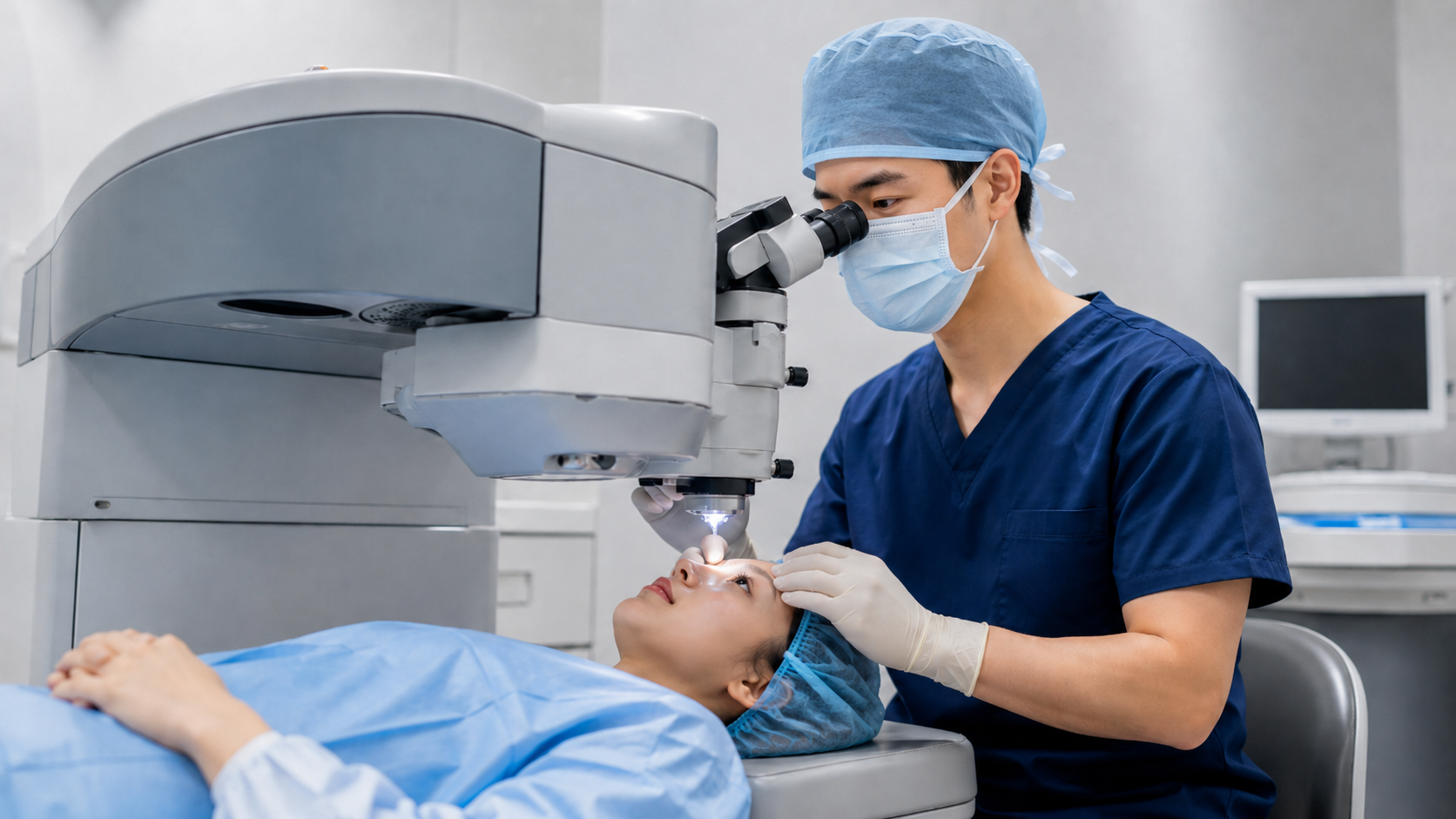
- Patient positioning under excimer laser
- Numbing eye drops applied; eyelid speculum inserted
- Microkeratome or femtosecond laser creates corneal flap
- Corneal flap lifted carefully, exposing treatment bed
- Patient fixation on target light during laser application
- Excimer laser precisely ablates corneal tissue per calculated pattern
- Corneal flap carefully repositioned and hydrated
- Patient rests while epithelial cells reseal flap
- Post-operative drops and protective sunglasses applied
PRK Procedure
- Comprehensive eye examination and corneal mapping
- Refraction determination and ablation pattern calculation
- Informed consent discussion
- Patient positioning under laser
- Numbing drops applied; eyelid speculum placed
- Mechanical brush or laser gently removes corneal epithelium
- Exposed treatment bed treated with excimer laser
- Laser precisely ablates stromal tissue per refraction
- Post-operative bandage contact lens placed
- Protective drops and medications applied
Hospitals Offering This


Doctors Performing This


Your Timeline
Preparation
- Discontinue contact lens wear 2-4 weeks before surgery (allows cornea to return to natural shape)
- Arrange for responsible adult to drive (cannot drive post-procedure)
- Pre-operative eye examination and measurements
- Discuss expectations, risks, limitations honestly with surgeon
- Avoid makeup and lotions day of surgery
- Plan time off work (typically 1-2 days for LASIK, 3-5 days for PRK)
Followup Care
LASIK Post-Op
- Protective eyewear (sunglasses) for first week
- Frequent prescribed eye drops for 3-6 months (critical for healing)
- Avoid water on face for first 48 hours (shower carefully)
- Avoid swimming and hot tubs for 1 week
- Avoid eye makeup for 1 week
- Avoid rubbing or touching eyes (critical; can displace flap)
- Avoid strenuous exercise for 1-2 weeks
- Light activity resumable next day; full activity after 1 week
- Sleep with protective eyewear for first few nights
- Follow-up appointments: 1 day, 1 week, 1 month, 3 months, 6 months, 1 year
PRK Post-Op
- Bandage contact lens remains 3-5 days; protects healing epithelium
- Frequent prescribed eye drops essential for comfort and healing
- Pain/discomfort common first 24-48 hours (managed with medications)
- Avoid water on face for first week
- Avoid swimming for 2 weeks
- Avoid makeup for 1 week
- Avoid rubbing or touching eyes
- Avoid strenuous exercise for 2-3 weeks
- Light activity after 3-4 days; full resumption after 2 weeks
- Sleep quality often disrupted first week due to discomfort
- Sunglasses recommended for light sensitivity first 2 weeks
- Follow-up appointments: 1 week, 1 month, 3 months, 6 months, 1 year
Frequently Asked Questions
Why is there a difference in recovery between LASIK and PRK?
LASIK preserves epithelium (top corneal layer) via flap creation, allowing rapid healing. PRK removes epithelium, requiring 3-5 days to regenerate. Faster LASIK healing allows sooner visual acuity and activity resumption.
Can I have both eyes treated same day?
Yes, bilateral same-day treatment is standard for both LASIK and PRK. Some surgeons prefer sequential treatment (one eye at a time) for select cases, but simultaneous treatment is safe and efficient.
Is LASIK or PRK permanent?
Yes, both procedures permanently reshape the cornea. The correction remains stable indefinitely. However, natural age-related presbyopia (difficulty focusing up close) develops normally after age 40-45.
Can I ever get glasses/contacts again if unhappy?
Yes, if LASIK/PRK results unsatisfactory, glasses or contacts can be worn over corrected eyes. However, contact lens fit may be more difficult due to corneal shape changes.
· Next Step
Interested in LASIK?
Connect with accredited specialists and get a personalised plan.