 Hospital
You You We, Go Go Go!
Cranial Implant (Cranioplasty)
Also known as:
- Facial Bone Surgery
- Orthognathic Surgery
- Cleft Jaw Surgery
- Le Fort Osteotomy
- Jaw Realignment
Recovery
- In the first few weeks, expect some swelling and mild tenderness as the scalp heals
- Most clients return to normal daily activities within 4–6 weeks
- Your custom implant provides immediate structural protection for your brain from the moment the surgery is complete
Considering Cranial Implant (Cranioplasty)?
Compare transparent pricing from vetted specialists in minutes.
About Cranial Implant (Cranioplasty)
Treated areas:
- Chin
- Cranium
- Jaw
- Midface
- Orbits
CRANIAL IMPLANTS (CRANIOPLASTY): Protection • Symmetry • Restoration
Precision Skull Reconstruction | Protecting Your Future with Advanced 3D Technology
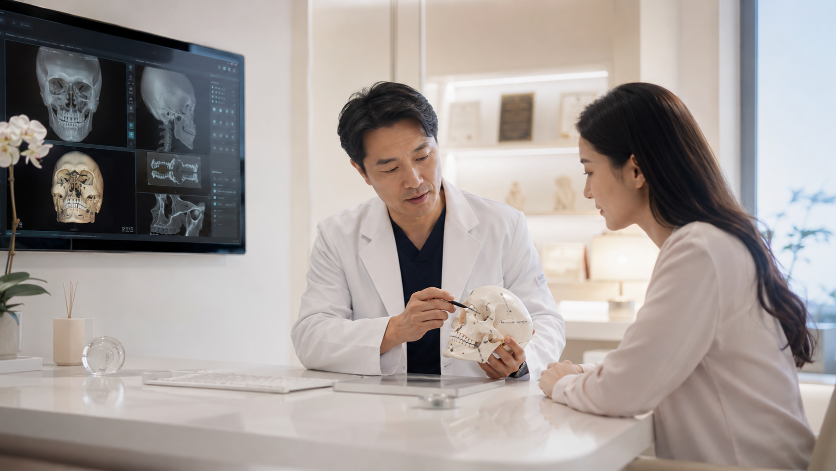
Cranial implants (Cranioplasty) are custom-engineered solutions used to rebuild or repair missing, damaged, or irregular parts of the skull. Whether following an injury, brain surgery, or birth difference, this procedure goes beyond aesthetics, it restores the vital protective barrier for the brain while returning the head to its natural, symmetrical shape. Every implant is designed using advanced 3D CT-scanning technology to ensure a seamless “lock-and-key” fit with your unique anatomy.
The 3D Precision Process
✨ Phase 1: 3D Mapping
We use high-resolution CT scans to create a digital 3D model of your skull. This allows us to map the exact dimensions of the missing or irregular area.
✨ Phase 2: Custom Fabrication
A Patient-Specific Implant (PSI) is engineered to fit the gap perfectly. This ensures shorter surgery times and the most accurate aesthetic result possible.
✨ Phase 3: Restoration
The implant is securely integrated into your skull. The result is a permanent, stable, and natural-feeling restoration of your cranial health and appearance.
What You Will Achieve
✅ Vital Brain Protection: Provides a high-strength shield over delicate brain tissue, eliminating dangerous soft spots.
✅ Natural Head Contour: Restores a smooth, even, and symmetrical skull shape that looks and feels authentic.
✅ Skeletal Balance: Provides permanent restoration of skeletal harmony and aesthetic facial proportions.
✅ Enhanced Comfort: Removes the sensation of pressure changes or sensitivity caused by missing bone.
✅ Functional Improvement: In cases of midface reconstruction, can lead to improved airway function and skeletal alignment.
✅ Permanent, Bio-Safe Results: Uses medical-grade, body-friendly materials designed to last a lifetime.
Advanced Implant Materials
| Material | Key Advantage | Why Choose It? |
| PEEK | Light, strong, and flexible. | Mimics natural bone; invisible on future MRI/CT scans. |
| Titanium | Ultra-strong and durable. | Best for major structural support and long-term safety. |
| Hydroxyapatite | Bone-like composition. | Encourages your natural bone to bond directly to it. |
| Autologous Bone | Your own skull bone. | The ultimate biological match with zero risk of rejection. |
Ideal Candidate
Suitable for adults and children who require structural skull correction.
You are the perfect candidate if you:
- Have a missing or sunken skull area following a trauma or accident
- Have a visible “dent” or irregularity after brain surgery or tumor removal
- Were born with skull shape differences that affect your appearance or comfort
- Experience discomfort or fear due to “soft spots” on your head
- Desire a symmetrical head shape to boost your self-confidence
- Need a durable, high-tech solution to protect your brain for the long term
How It Is Performed
- 3D CT / CBCT Imaging & Dental Models — Comprehensive imaging and dental casting completed; virtual surgical planning performed by maxillofacial team.
- Pre-Operative Orthodontics — Dental alignment preparation (if applicable) over months preceding surgery.
- Multi-Stage Surgery — Osteotomies planned and sequenced; typical procedures include Le Fort I/II/III midfacial osteotomy + BSSO mandibular correction + genioplasty + soft-tissue advancement; titanium mini-plates used for rigid fixation.
- ICU Step-Down Recovery — 24–48 hours ICU monitoring; airway management, IV nutrition, swelling control.
- Inpatient Physiotherapy & Nutrition — Nasogastric or soft-diet nutrition for 2–6 weeks; jaw-opening exercises.
- Long-Term Orthodontic Finalisation — Post-surgical orthodontics continues for 6–18 months to achieve final dental occlusion.
Hospitals Offering This
Doctors Performing This

Your Timeline
Preparation
- Complete pre-operative 3D CT CBCT scan
- Dental model fabrication
- Cardiopulmonary clearance for general anaesthesia
- Blood product cross-match
- Pre-operative orthodontic preparation (where applicable)
- Multi-disciplinary team assessment: plastic surgeon, maxillofacial surgeon, orthodontist, anaesthesiologist
Frequently Asked Questions
What is the risk of nerve damage?
Temporary numbness of the lower lip and chin (inferior alveolar nerve territory) is common after mandibular osteotomy, typically resolving over 3–18 months. Permanent nerve damage is rare in experienced surgical teams.
How long before I can eat normally?
A soft diet is required for approximately 6 weeks post-operatively. Full unrestricted dietary return follows final orthodontic occlusal confirmation.
· Next Step
Interested in Cranial Implant (Cranioplasty)?
Connect with accredited specialists and get a personalised plan.