 Hospital
You You We, Go Go Go!
Braces / Clear Aligners/ Invisalign
Also known as:
- Orthodontic Alignment
- Invisible Braces
- Clear-Aligner Orthodontics
- Teeth Straightening
Recovery
- There is no recovery period for orthodontic treatments
- You may feel mild pressure or soreness during the first week as your teeth begin their journey
- You can continue your daily routine, work, and exercise immediately
Considering Braces / Clear Aligners/ Invisalign?
Compare transparent pricing from vetted specialists in minutes.
About Braces / Clear Aligners/ Invisalign
Treated areas:
- Teeth
ORTHODONTICS: Align • Correct • Perfect
Precision Smile Straightening | Achieve Healthier Teeth and Lasting Confidence
Orthodontic treatment is about more than just a straight smile; it’s about creating a healthy, functional bite and teeth that are easier to maintain for a lifetime. Whether you prefer the high-precision power of Traditional Braces or the discreet flexibility of Clear Aligners (Invisalign), modern orthodontics can close gaps, resolve crowding, and correct bite issues like overbites or underbites with greater comfort than ever before.
What You Will Achieve
✅ Perfect Alignment: Straightens crooked or rotated teeth into a symmetrical, beautiful arch.
✅ Seamless Spacing: Closes unwanted gaps and eliminates “black triangles” between teeth.
✅ Functional Bite: Corrects overbites, underbites, and crossbites, making chewing more efficient and reducing jaw strain.
✅ Improved Oral Health: Straighter teeth are easier to brush and floss, significantly lowering your risk of cavities and gum disease.
✅ Enhanced Confidence: Gives you the freedom to smile openly in photos, social gatherings, and professional settings.
✅ Long-term Stability: With the use of retainers, your new smile is designed to stay perfect for life.
Choosing Your Path to a Better Smile
| Feature | Traditional Braces | Clear Aligners (Invisalign) |
| Best For | Complex cases & severe jaw alignment. | Mild to moderate crowding & gaps. |
| Visibility | Metal or tooth-colored ceramic. | Nearly Invisible high-tech plastic. |
| Diet | Avoid sticky/hard foods. | No restrictions (Removable for eating). |
| Maintenance | Fixed (Stay on 24/7). | Removable (Easy to brush and floss). |
| Comfort | Periodic wire pressure. | Smooth, custom-molded trays. |
Ideal Candidate
Suitable for children, teens, and adults who want to improve their dental function and aesthetics.
You are the perfect candidate if you:
- Have crowded, crooked, or overlapping teeth.
- Have noticeable gaps or spaces between your teeth.
- Experience difficulty chewing or have an “uneven” bite.
- Are a professional seeking a discreet way to straighten your teeth (Invisalign).
- Want to invest in your long-term dental health by making your teeth easier to clean.
How It Is Performed
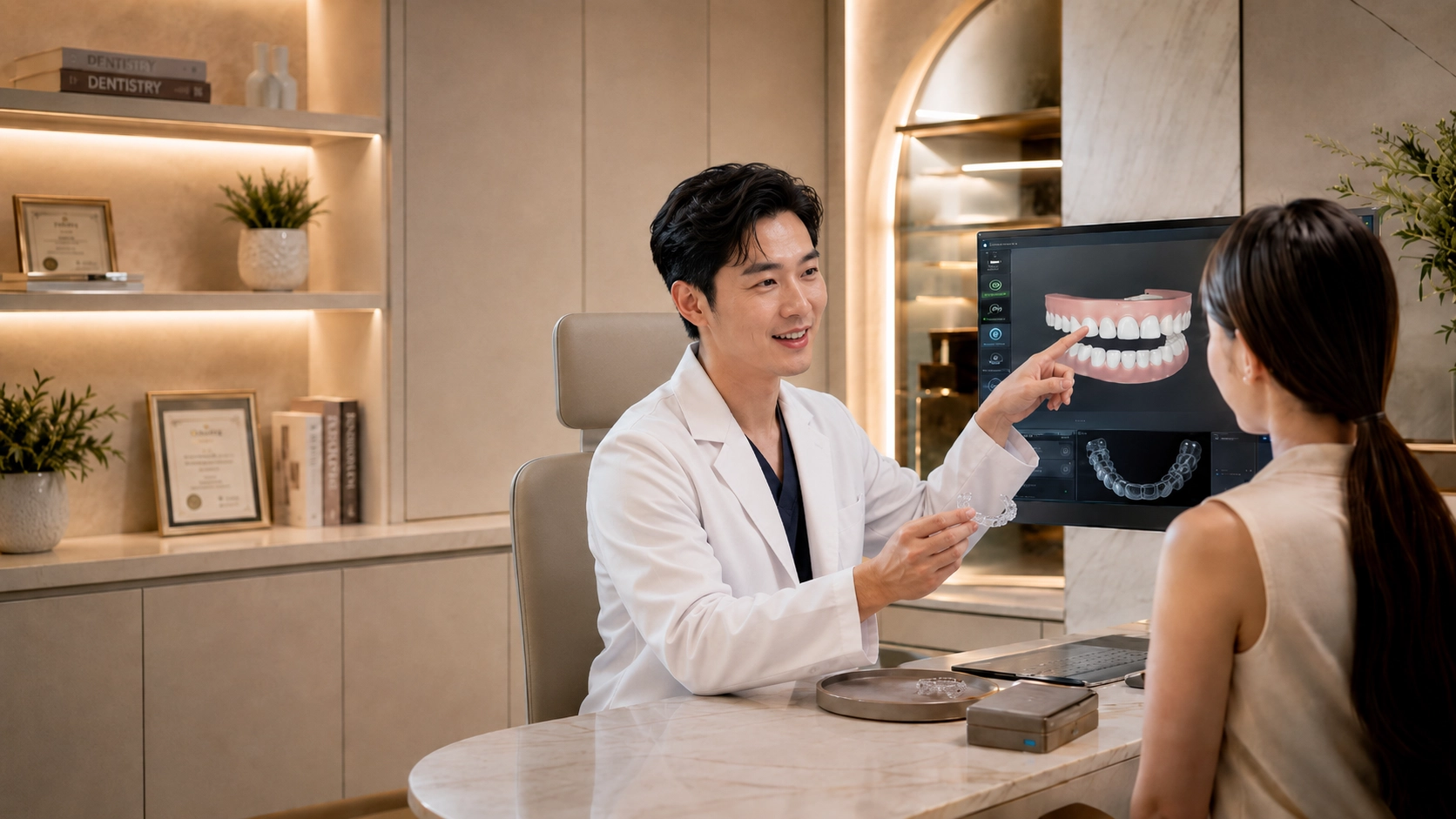
- Digital scan: Intraoral 3-D digital scan replaces messy physical impressions
- ClinCheck treatment plan: Digital simulation shows the predicted tooth movement at every stage and the expected final result — reviewed and approved by the patient before treatment begins
- Aligner fabrication: Series of custom aligners manufactured and delivered
- Treatment: Aligners worn 22 hours/day; removed only for eating and oral hygiene
- Progress reviews: Every 6–8 weeks the dentist checks tooth movement; attachments (small tooth-coloured composite buttons) may be added to help move specific teeth
- Retention: Fixed or removable retainer worn after the active phase to maintain results




Doctors Performing This




Your Timeline
Preparation
Full periodontal health assessment; caries control before starting
Radiograph series (orthopantomogram ± cephalogram)
Discussion of realistic outcomes for the severity of malocclusion present
Followup Care
- Retainer compliance is lifelong — teeth relapse without it
- Excellent oral hygiene critical — aligners are removed for meals; brush teeth before reinserting
- 6-monthly dental recalls for hygiene and retainer check
Frequently Asked Questions
Can Invisalign fix all types of misalignment?
Invisalign handles mild-to-moderate crowding, spacing, and bite issues effectively. Severe skeletal discrepancies (significant overbite, underbite) may require combined orthodontic + orthognathic surgical correction.
· Next Step
Interested in Braces / Clear Aligners/ Invisalign?
Connect with accredited specialists and get a personalised plan.