 Hospital
You You We, Go Go Go!
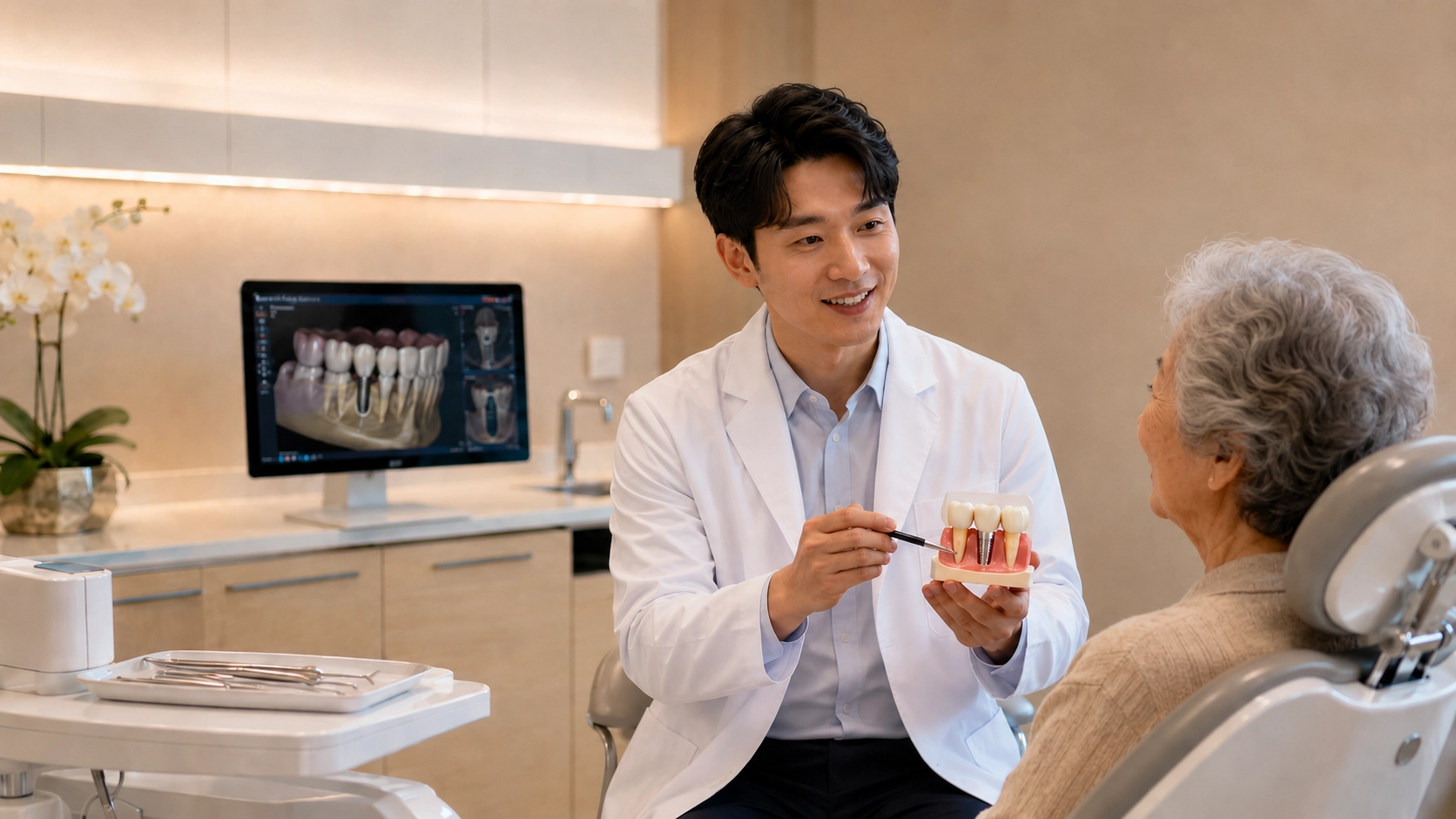
Dental Implant
Also known as:
- Tooth Implant
- Missing Tooth Replacement
- Implant Dentistry
Recovery
- Most clients return to work the very next day
- Minor swelling or tenderness is normal and typically fades within 2–3 days
Considering Dental Implant?
Compare transparent pricing from vetted specialists in minutes.
About Dental Implant
Treated areas:
- Gum
- Teeth
DENTAL IMPLANTS: Strong • Natural • Permanent
The Gold Standard for Missing Teeth | Eat, Speak & Smile with Total Confidence
Dental implants are the ultimate permanent solution for replacing missing teeth. Unlike traditional dentures that can slip or shift, an implant is a high-tech titanium “root” that is securely placed into your jawbone. Once it bonds with your body, it provides a lifetime of strength, allowing you to enjoy your favorite foods and smile brightly without a second thought.
The 3-Part Design
✨ The Post: A small, biocompatible titanium screw that acts as your new tooth root.
✨ The Abutment: A sturdy connector that joins the post to your new tooth.
✨ The Crown: The visible, custom-crafted tooth designed to match your natural smile perfectly.
What You Will Achieve
✅ Natural Look & Feel: Every crown is customized in color and shape to blend seamlessly with your existing teeth.
✅ Bone Health Preservation: Implants stimulate the jawbone just like real roots, preventing the “sunken” facial appearance caused by bone loss.
✅ Lifetime Durability: While bridges may need replacing, a well-cared-for implant can last for decades.
✅ Dietary Freedom: Eat anything you like from steak to crunchy apples with no worrying about slipping or discomfort.
✅ Protection for Healthy Teeth: Unlike traditional bridges, we don’t need to grind down your neighboring healthy teeth to support the new one.
✅ Speech Clarity: Unlike loose dentures, implants stay fixed in place so you can speak clearly and confidently.
Restoration Options
| Option | Best For |
| Single Tooth | Replacing one missing tooth without touching the neighbors. |
| Implant Bridge | Replacing several teeth in a row with maximum stability. |
| All-on-4® / All-on-6® | Replacing an entire upper or lower arch of teeth permanently. |
| Snap-on Denture | Improving the stability of removable dentures with an implant “click” system. |
Ideal Candidate
Suitable for adults who have finished their facial growth and seek a permanent dental solution.
You are the perfect candidate if you:
- Have one, several, or even all teeth missing.
- Are tired of the inconvenience and discomfort of removable dentures.
- Have healthy gums and enough jawbone to support the titanium post.
- Want a high-strength solution that allows you to eat any food you enjoy.
- Seek to maintain a youthful facial structure by preventing jawbone shrinkage.
How It Is Performed
Phase 1 — Site preparation (if needed)
Tooth extraction (if tooth remains), socket healing 6–8 weeks; bone grafting if bone volume is insufficient (+ 3–4 months healing)
Phase 2 — Implant placement
CBCT-guided surgical guide fabricated → local anaesthesia → incision at treatment site → drilling of precise osteotomy → titanium implant (typically 3.5–5.0 mm diameter; 8–14 mm length) placed → healing cap → suture → 8–12 weeks osseointegration healing
Phase 3 — Crown delivery
Implant stability confirmed by resonance frequency analysis → abutment placed → digital impression or conventional impression → CAD/CAM ceramic crown fabricated → cemented or screw-retained














Your Timeline
Preparation
- Full periodontal assessment — active gum disease must be controlled before implant placement
- CBCT scan to assess bone volume and identify anatomical boundaries (inferior alveolar nerve, sinus floor)
- Dental hygiene session; caries control
- Medical history for anticoagulant use, bisphosphonate use, immunosuppression (contraindications)
Followup Care
- Soft diet for 14 days post-placement; no pressure on implant during osseointegration
- Oral hygiene with interdental brushes around the implant daily; waterflosser recommended
- Avoid smoking — significantly impairs osseointegration success rate
- 6-monthly recall appointments for implant maintenance and peri-implant tissue monitoring
Frequently Asked Questions
Does it hurt?
The placement procedure is performed under local anaesthesia, the surgery itself is painless. Mild post-operative soreness for 3–5 days is managed with standard analgesics.
How is an implant different from a bridge?
A bridge crowns the neighbouring teeth to span the gap, those teeth must be ground down. An implant requires no involvement of adjacent teeth and preserves the jawbone beneath, which a bridge cannot do.
· Next Step
Interested in Dental Implant?
Connect with accredited specialists and get a personalised plan.