Liposuction vs. Onda Coolwaves: Can Microwaves Really Replace Surgery?
Every few years, body contouring gets a new futuristic treatment.
The latest device promises less downtime.
A new energy technology appears.
Another treatment says it can reshape the body without surgery.
Then there’s liposuction.
It has been around for decades.
So when something like Onda Coolwaves comes along using microwave energy to target tissue beneath the skin it is fair to wonder:
Has technology finally made liposuction unnecessary?
Not quite.
And the reason is more interesting than simply saying one treatment is surgical and the other isn’t.
The Strange Longevity of Liposuction
Think about how much cosmetic technology has changed.
We now have treatments designed to contour the body without making a surgical incision. We have devices that use heat, cooling, radiofrequency, ultrasound and other forms of energy.
Yet liposuction is still part of the conversation.
Why?
Because its basic proposition remains remarkably straightforward:
If localized fat is the problem, fat can be physically removed.
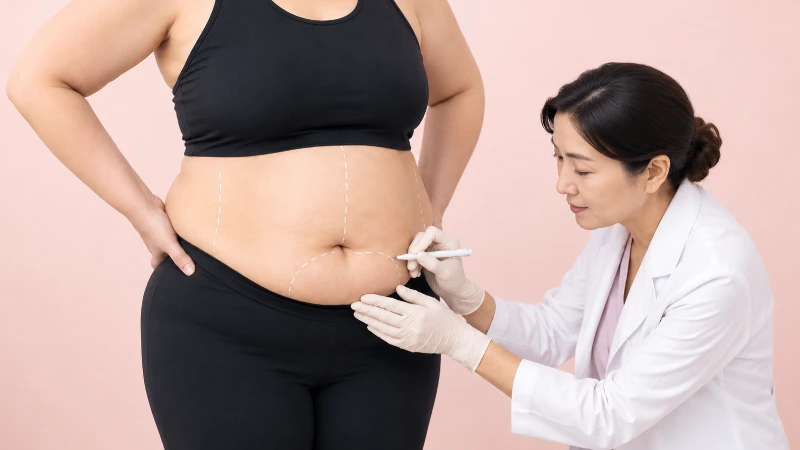
During liposuction, a cannula is used to remove fat from selected areas.
There is no mystery about what makes the treatment fundamentally different.
It is surgery.
And for someone who wants a significant reduction in localized fat, that directness can be exactly the point.
Then Onda Arrives With a Completely Different Idea
Onda Coolwaves doesn’t try to recreate liposuction without a cannula.
That’s an important distinction.
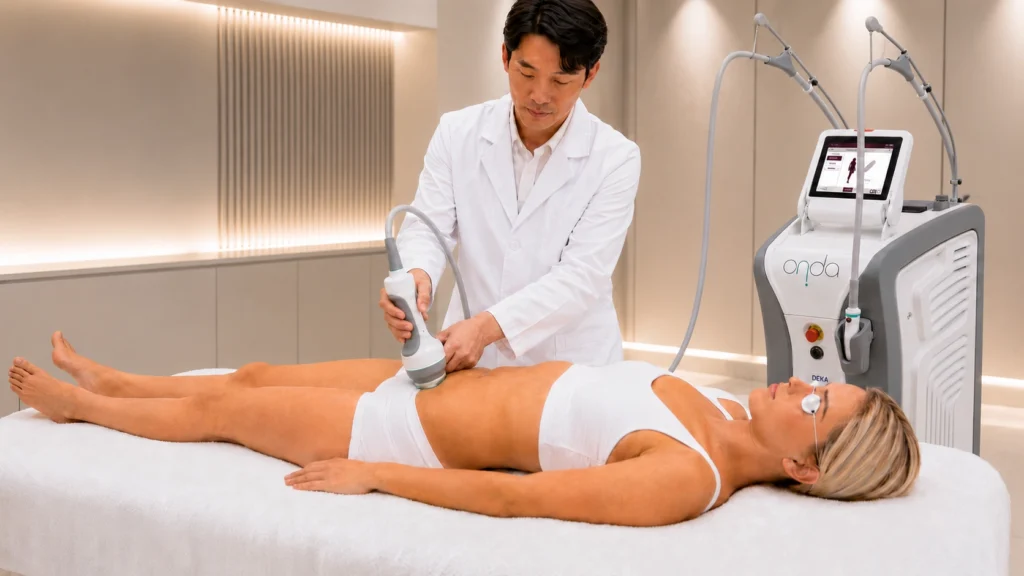
Onda uses 2.45 GHz microwave energy delivered through the skin as a non-invasive body-contouring approach.
Its treatment applications include localized adiposity, cellulite and skin laxity.
In other words, the attraction isn’t simply:
“It’s another way to remove fat.”
The appeal is that body contouring doesn’t always begin and end with fat.
Sometimes the complaint is about the way an entire area looks.
A little cellulite.
Some skin laxity.
An uneven-looking surface.
Localized fullness.
Or a combination of several things.
And suddenly, a non-invasive approach becomes much more interesting.
Same Body Part. Completely Different Priorities.
Take the waist.
One person might look in the mirror and think:
“I have too much fat here.”
Another might think:
“My waist looks bulky and the skin doesn’t look as smooth as I’d like.”
They may point to exactly the same place.
But they aren’t necessarily asking for the same thing.
This is why comparing body-contouring treatments purely by body part can be misleading.
“Belly.”
“Thighs.”
“Arms.”
“Love handles.”
Those words tell you where the concern is.
They don’t tell you what kind of change you’re looking for.
Where Onda Makes the Conversation More Interesting
Imagine you don’t want surgery.
That alone can change the shortlist.
Perhaps your concern is relatively localized. Perhaps you are interested in improving the appearance of an area rather than pursuing surgical fat removal.
Onda may then become a treatment worth discussing.
And because its applications extend to concerns such as cellulite and skin laxity, the conversation isn’t necessarily limited to:
“How much fat can we remove?”
It can become:
“What can we improve about this area without surgery?”
That’s a very different question.
But Here’s Where Liposuction Still Has an Edge
There is a reason people continue to choose a surgical approach despite the growing number of non-invasive options.
Sometimes they actually want the fat removed.
Not softened.
Not treated with energy.
Not simply improved around the edges.
Removed.
If someone has a persistent pocket of localized fat and wants a more direct surgical approach to reducing it, liposuction remains highly relevant.
This is also why calling Onda a “replacement” for liposuction can be misleading.
A replacement suggests two products doing essentially the same job.
They’re not.
The Problem With Calling Something “Better”
“Better” is one of the most overused words in aesthetic treatment comparisons.
Better for what?
Better if you want to avoid surgery?
Better if localized fat removal is your priority?
Better if cellulite is part of your concern?
Better if you want a more substantial contour change?
Better if the amount of downtime you can accept is your biggest consideration?
Suddenly, there isn’t one winner.
There are simply different priorities.
And that makes the question much more useful:
What matters most to you, the way the treatment works, or the type of change you’re hoping to see?
Don’t Let Before-and-After Photos Make the Decision for You
This is where online research gets particularly tricky.
You see a dramatic liposuction result.
Then you see an impressive Onda result.
Which one looks better?
It sounds like an easy question.
It isn’t.
You don’t know whether the people started with the same amount of localized fat.
You don’t know whether their skin laxity was similar.
You don’t know whether cellulite was part of the concern.
You don’t know whether their treatment goals were identical.
And you certainly don’t know what happened outside the frame.
A before-and-after photograph is useful for showing that change occurred.
It is much less useful for telling you which treatment you should choose.
The Part Nobody Likes to Hear: Non-Invasive Doesn’t Mean Identical
There is an understandable temptation to think:
“If I can get a result without surgery, why would anyone choose surgery?”
Because avoiding surgery and achieving a particular level of change are two separate priorities.
Non-invasive treatment can be very appealing.
But that doesn’t mean it should automatically be expected to produce the same type or scale of contour change as surgical fat removal.
And “non-invasive” doesn’t mean “nothing happens.”
Depending on the treatment and area, temporary warmth, discomfort, redness, swelling or tenderness may occur.
The point isn’t to make one option sound worse.
It’s to keep expectations realistic.
Why New Technology Doesn’t Automatically Kill the Old Technology
This is the bigger story behind the Onda-versus-liposuction debate.
Beauty technology often moves in one direction:
less invasive.
That’s appealing.
People understandably want results with fewer procedures, less disruption and an easier treatment experience.
But innovation doesn’t necessarily make older treatments obsolete.
Sometimes it simply creates more choices for different people.
Onda doesn’t have to defeat liposuction to be useful.
Liposuction doesn’t have to defeat Onda to remain relevant.
They can occupy different places in the same body-contouring landscape.
And that’s probably a more realistic way to look at aesthetic technology in general.
So Which Person Is Looking at Which Option?
“I really don’t want surgery.”
A non-invasive approach may be worth exploring.
“I want this localized fat physically reduced.”
Liposuction becomes a more relevant discussion.
“The area isn’t just about fat. There’s also cellulite or skin laxity.”
A treatment such as Onda may be worth discussing because its applications extend beyond localized adiposity.
“I want a major change in the shape of this area.”
The conversation needs to include the expected scale of change, not simply whether a treatment is new or non-invasive.
“I’m not sure what the actual problem is.”
That’s fine.
You don’t need to arrive with the name of a treatment.
So… Can Microwaves Really Replace Surgery?
Not in the straightforward way the headline suggests.
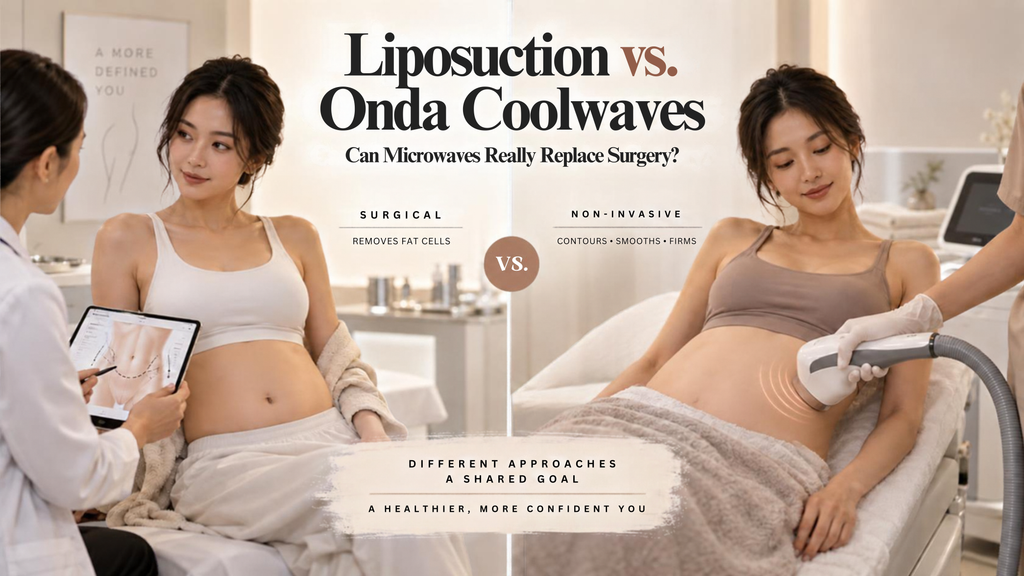
Onda Coolwaves and liposuction are fundamentally different approaches.
Onda uses microwave energy through the skin as a non-invasive body-contouring treatment, with applications including localized adiposity, cellulite and skin laxity.
Liposuction uses surgery to physically remove localized fat.
One isn’t simply the futuristic version of the other.
And that’s actually good news.
It means the choice isn’t about finding the treatment that has “won.”
It’s about having more than one way to approach a body-contouring concern.
Start With the Body. Not the Technology.
The easiest mistake is to fall in love with a treatment before deciding what you want from it.
Onda sounds futuristic.
Liposuction sounds established.
Neither description tells you whether either approach makes sense for your particular concern.
Before choosing a procedure, be clear about three things:
What bothers you?
What kind of change are you hoping for?
How important is avoiding surgery?
Once those answers are clearer, comparing treatments becomes much easier.
Because the most useful body-contouring decision isn’t necessarily:
“Which technology is the most advanced?”
It may simply be:
“Which approach makes the most sense for the result I’m trying to achieve?”
Exploring Body Contouring in Asia Pacific?
You don’t have to decide between Onda and liposuction before speaking with a specialist.
If you’re considering treatment abroad, BeautsGO can help you explore available body-contouring approaches with clinics and hospitals across Asia Pacific.
Share the area you’re concerned about, what you’d like to improve and any relevant information. BeautsGO can coordinate with appropriate specialists so you can understand the treatment approaches available and estimated costs before making a commitment.
Technology changes. Your goal comes first.