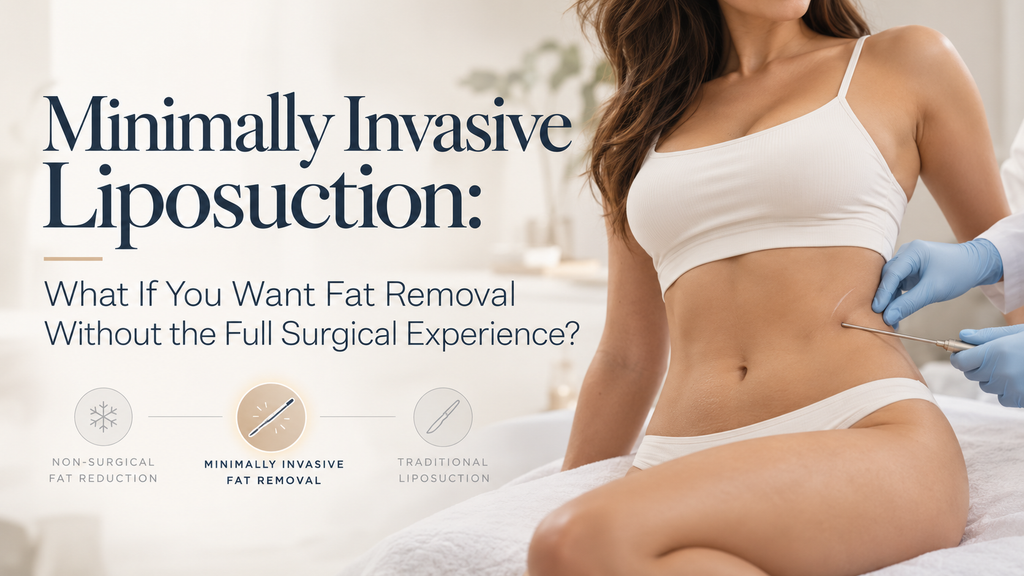
Minimally Invasive Liposuction: What If You Want Fat Removal Without the Full Surgical Experience?
Key takeaways
- Minimally invasive fat removal is not simply “traditional liposuction, but smaller.”
- And non-surgical fat reduction is not simply “liposuction without surgery.”
- They are different approaches.
- The interesting part is that you now have a way to tell them apart:
- Is the fat being physically removed?
- How extensive is the treatment?
- What kind of recovery is involved?
- And does that approach match the change you actually want?
- Once you answer those questions, the procedure name becomes much less important.
“Minimally invasive.”
“Non-surgical.”
“Liposuction.”
Three terms that sound like they should be easy to understand.
They aren’t.
If you have been researching body contouring, you may have noticed that some treatments promise fat reduction without surgery, while others describe themselves as minimally invasive fat removal.
So what is the actual difference?
Here is the simplest way to think about it:
If the fat is being physically removed, something has to reach the fat.
The interesting question is how it reaches it.
And that is where minimally invasive fat removal sits between conventional liposuction and non-surgical body contouring.
First, Forget the Marketing Labels
“Non-surgical.”
“Minimally invasive.”
“Lipo.”
“Fat reduction.”
“Body contouring.”
These terms can make different treatments sound almost interchangeable.
They aren’t.
The first thing to look at is not the name of the treatment.
Look at what happens to the fat.
Is the fat physically removed?
If yes, you are looking at a fat-removal procedure.
Is the fat targeted without physically extracting it?
That falls into non-surgical fat-reduction territory.
This one distinction makes the rest of the terminology much easier to understand.
So What Makes Liposuction “Minimally Invasive”?
Traditional liposuction already uses relatively small access points to insert a cannula and remove fat.
So why do some treatments use the term “minimally invasive”?
Usually, the difference is about the overall extent of the procedure, such as the treatment area, amount of fat addressed, anesthesia approach and level of surgical intervention.
A minimally invasive technique may be designed for more targeted fat removal rather than extensive body sculpting.
That can be appealing to someone who doesn’t need or doesn’t want a larger-scale procedure.
But there is an important point:
Smaller access does not automatically mean smaller results, and it does not automatically mean a better treatment.
The treatment still needs to match the goal.
Why Would Someone Choose This Middle Ground?
Think about the range of choices.
At one end:
“I don’t want anything invasive.”
At the other:
“I want extensive body sculpting.”
In between is a person saying:
“I want the fat physically removed, but I would prefer a less extensive treatment if it can address my concern.”
That is the person most likely to investigate minimally invasive fat removal.
The appeal may include:
- A more targeted treatment
- Direct removal of fat
- Potentially less extensive anesthesia
- Smaller access points or specialized cannulas, depending on the technique
- Potentially less disruption to daily life
But these are features to investigate, not guarantees.
Recovery still depends on the treatment, area and individual.
Minimally Invasive Does Not Mean No Recovery
This is one of the easiest assumptions to make.
A treatment can be minimally invasive and still involve:
- Swelling
- Bruising
- Tenderness
- Numbness
- Temporary changes in the treated area
- Activity restrictions
For example, 365mc’s published LAMS aftercare information describes temporary swelling, bruising, numbness, mild pain and other changes following treatment.
So instead of asking:
“How much downtime does it have?”
ask:
“What will recovery look like for this exact treatment and treatment area?”
That is a much more useful question.
Then What Is Non-Surgical Fat Reduction?
Now we can separate the two.
Non-surgical fat reduction does not physically suction fat out.
Depending on the technology, it may use cooling, heat, ultrasound, radiofrequency or injectable approaches to target fat.
The American Society of Plastic Surgeons distinguishes non-surgical fat reduction from liposuction and notes that these approaches are generally intended for fat reduction rather than replacing surgical liposuction.
So:
Non-surgical = target the fat without surgical extraction.
Minimally invasive = direct fat removal through a less extensive approach, depending on the technique.
Traditional liposuction = surgical fat removal that can be used for broader contouring.
Suddenly, “minimally invasive” becomes much easier to understand.
Where Does 365mc LAMS Fit?
This is where things get particularly interesting for anyone researching aesthetic treatment in Korea.
LAMS is a specific technique developed by 365mc.
According to 365mc, LAMS uses a specialized cannula to directly extract fat from targeted areas under local anesthesia, without traditional surgical incisions or general anesthesia. 365mc also describes the technique as combining fat extraction with fat-dissolving injections.
That makes LAMS a useful example of minimally invasive fat removal.
But don’t make this leap:
LAMS = minimally invasive liposuction
A better way to understand it is:
LAMS is one specific technique within the broader conversation about minimally invasive fat removal.
That distinction matters when you are comparing different clinics, techniques and treatment plans.
LAMS vs Traditional Liposuction: Is One Better?
This is probably the wrong question.
A better question is:
“Which approach is designed for the amount of change I want?”
The table is deliberately simple because the point isn’t to choose your procedure from a blog.
It is to understand what you are actually comparing.
Here’s Where “Small” Can Become Misleading
A smaller procedure sounds attractive.
But imagine two very different goals:
Goal A:
“I want to reduce a small pocket of fat under my chin.”
Goal B:
“I want my abdomen, waist and flanks significantly reshaped.”
Both people could search for “liposuction.”
But they are not asking for the same thing.
The amount of fat, treatment area, skin quality, body proportions and desired result can all change the treatment discussion.
So don’t judge a procedure by how small it sounds.
Judge it by whether it can realistically address the goal you have in mind.
What About Results?
This is where expectations matter.
Minimally invasive does not mean:
“traditional liposuction results, but easier.”
It also does not mean:
“no recovery, no risks and no compromise.”
Different techniques have different capabilities.
The realistic outcome depends on factors such as:
- How much fat is present
- Where the fat is located
- Skin elasticity
- Treatment area
- Technique used
- Amount of fat removed
- Individual healing
That is why before-and-after photos can be useful for understanding a technique, but they should not be treated as a promise of what another person will achieve.
Maybe the Better Question Is: “How Much Intervention Do I Want?”
This is a more interesting way to think about body contouring.
You can picture the options as a spectrum:
No procedure
↓
Non-surgical fat reduction
↓
Minimally invasive fat removal
↓
Traditional liposuction
↓
More extensive body-contouring surgery
Moving along that spectrum generally means accepting different levels of intervention in exchange for different treatment capabilities.
There is no universal “best” position.
The right conversation depends on the change you want.
Before You Choose, Ask These Questions
Don’t walk into a consultation with only:
“How much does it cost?”
Ask:
1. Is my goal fat reduction or body contouring?
2. Will the fat actually be physically removed?
3. How much of the area can realistically be treated?
4. What type of anesthesia is used?
5. What will recovery look like for my specific treatment?
6. If I am travelling abroad, how will follow-up work after I return home?
Those questions will tell you much more than the phrase “minimally invasive” ever could.
Exploring Liposuction and Body Contouring in Asia?
You don’t need to arrive with a treatment name already chosen.
BeautsGO helps international clients explore aesthetic treatment options across Asia by coordinating their information with clinics and hospitals for specialist review.
You can understand potential treatment options and estimated costs before making a commitment, while also getting support with the practical side of an overseas treatment journey.
The specialist determines what may be appropriate.
You decide what you want to explore.
And sometimes, understanding the difference between non-surgical, minimally invasive and surgical is the most useful first step of all.